
Immigration Case Management Software:Essential Features Every UK Immigration Law Firm Needs
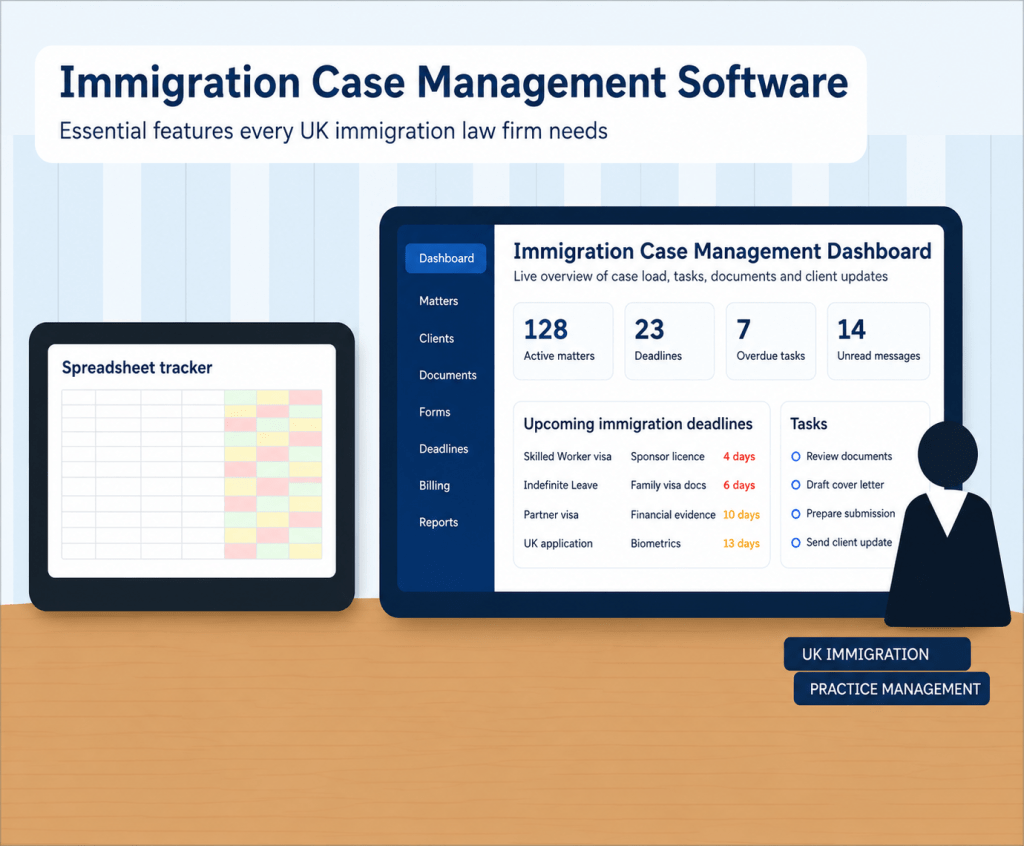
Introduction Immigration law is one of the most document-heavy, deadline-driven and client-sensitive areas of legal practice in the UK. Every matter – whether it concerns a Skilled Worker visa, sponsor licence, spouse or partner visa, asylum claim, human rights application, student visa, settlement application or immigration appeal – involves strict evidential requirements, detailed client instructions, Home Office correspondence, forms, fees, deadlines and ongoing communication. For a busy immigration law firm, managing this work through spreadsheets, shared folders and email inboxes quickly becomes difficult. A single missed appeal deadline, lost refusal letter, incomplete evidence bundle or unrecorded client instruction can have serious consequences for the client and the firm. Professional immigration case management software gives firms a single, secure and structured platform to manage each matter from first enquiry to final outcome. It helps fee earners reduce administration, improve visibility, standardise workflows and give clients a more professional service. This article explains the essential features every UK immigration law firm should look for when selecting case management software and how a modern platform such as Casetrak.ai can support immigration teams in practice. Why Immigration Law Firms Need Specialist Case Management Software Generic office tools were not designed for the realities of immigration work. Immigration matters combine legal advice, client care, regulatory duties, multi-stage evidence collection, Home Office portals, tribunal deadlines and sensitive personal data. A firm may be managing hundreds of live matters at different stages, each with its own documents, dates, tasks and risk profile. The problem is not only volume. Immigration clients may be under significant personal pressure because their work, family life, education, status or safety depends on the outcome of the matter. They often need regular reassurance and clear instructions about what is required next. When communication is slow or fragmented, clients lose confidence and firms spend more time answering avoidable status queries. Specialist case management software solves these problems by giving lawyers, paralegals and support teams a shared operational system. Instead of relying on individual memory, inboxes or spreadsheet trackers, everyone can see the status of a matter, outstanding documents, upcoming deadlines and next actions. Essential Feature 1: Centralised Matter and Client Management The foundation of any immigration case management system is a centralised client and matter record. Each matter should hold all key information in one place, including client details, immigration category, matter stage, Home Office reference numbers, linked parties, assigned fee earners, key dates, documents, tasks, notes and financial information. This is particularly important in immigration law because one client may have several related matters over time. For example, a client may start with a Skilled Worker visa, later apply for dependant visas for family members, then apply for indefinite leave to remain and eventually citizenship. A good system should help the firm maintain continuity across the client journey. Centralisation also improves supervision. Partners and managers can review workload, check high-risk matters and identify delays without requesting manual updates from each fee earner. Essential Feature 2: Structured Immigration Workflows Immigration matters follow repeatable stages, even though every client’s facts are different. A strong system should allow firms to create workflow templates for common matter types, such as spouse visas, Skilled Worker applications, sponsor licence applications, asylum claims, administrative reviews and tribunal appeals. Each workflow can include standard tasks, responsible owners, document checklists, internal review points and deadline reminders. This helps junior staff follow the correct process and reduces the risk of missing important steps. For example, a spouse visa workflow may include initial eligibility review, client-care documentation, relationship evidence, financial evidence, accommodation evidence, English-language evidence, application drafting, client review, submission, biometrics, outcome tracking and post-decision advice. An asylum appeal workflow will require a very different process, including refusal review, appeal deadline calculation, evidence gathering, witness statements, bundle preparation and hearing management. Essential Feature 3: Deadline and Calendar Management Deadline management is one of the most important requirements for immigration firms. Appeal and review deadlines can be short and unforgiving. GOV.UK guidance explains that immigration and asylum tribunal appeal timing can differ depending on whether the appellant is inside or outside the UK, with 14-day and 28-day timeframes applying in common appeal scenarios. A case management system should help firms record and monitor deadlines centrally, with reminders, escalation rules and visibility across the team. It should support court and tribunal dates, Home Office response dates, biometric appointments, sponsor licence renewal dates, visa expiry dates, right-to-work follow-up dates and internal review deadlines. The system should not replace professional judgement. Fee earners must still check the relevant decision letter, procedural rules and client circumstances. However, once a deadline is verified, the system should make it difficult for that date to be missed. Essential Feature 4: Document Collection and Evidence Management Immigration practice depends on evidence. Firms regularly request passports, BRPs or eVisas, refusal letters, payslips, bank statements, tenancy agreements, employment letters, sponsor documents, relationship evidence, educational records, medical records and witness statements. Without a structured system, evidence collection quickly becomes chaotic. Documents may arrive by email, WhatsApp, post or file-share link. They may be misnamed, duplicated, incomplete or saved in the wrong folder. Effective immigration case management software should support secure document upload, document checklists, document categories, version control, missing-evidence tracking and matter-based storage. It should also allow the firm to see which documents have been requested, received, reviewed and approved. This is a major area where Casetrak.ai can help. By connecting document requests, client portal uploads and matter records, firms can reduce the time spent chasing attachments and manually saving files. Essential Feature 5: Secure Client Portal A client portal is increasingly important for immigration firms. Clients need a safe and simple way to upload documents, complete questionnaires, receive updates and communicate with their legal team. A secure portal is preferable to relying entirely on email attachments, especially where documents contain sensitive personal, financial, employment, family or protection-related information. The SRA provides guidance on solicitors’ obligations around keeping client information confidential, and firms should ensure their technology choices support those duties. A good immigration client
How Immigration Law Firms Can Reduce Administrative Work in Visa and Asylum Matters
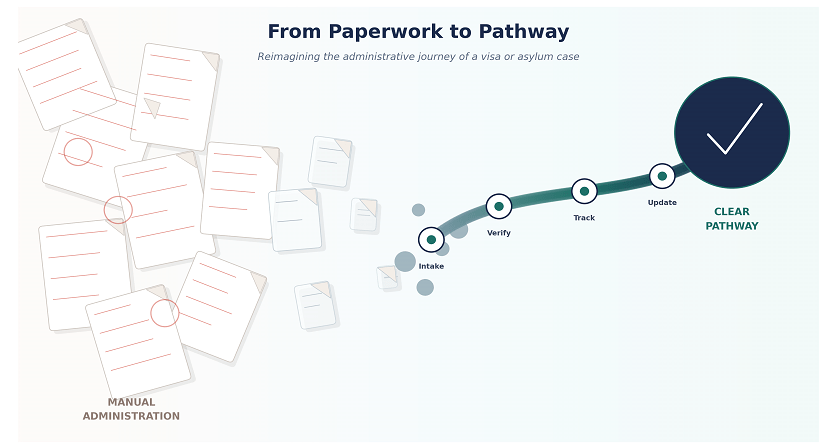
How Immigration Law Firms Can Reduce Administrative Work in Visa and Asylum Matters Visa and asylum casework has never generated more paperwork per fee-earner hour. The shift to digital eVisas, a still-substantial asylum appeals backlog, and tightening margins on fixed-fee and legal aid work all add administrative load at exactly the moment firms need fee-earners spending more time on legal judgment, not data entry. This article sets out where that administrative burden actually comes from in UK immigration practice and the concrete steps firms can take to reduce it — without compromising the regulatory obligations that come with the work. Why Administrative Burden Is Rising Across UK Immigration Practice Three structural changes are driving up non-billable administrative time in immigration teams right now. The end of physical immigration documents The Home Office has phased out Biometric Residence Permits and visa vignettes in favour of digital eVisas, accessed through a UK Visas and Immigration (UKVI) account and proven to third parties using time-limited share codes. Firms holding expired BRPs or BRCs for clients can still use them to link a UKVI account, but only until 31 December 2026, after which the physical document is no longer accepted for that purpose. That deadline, combined with a parallel rollout of Electronic Travel Authorisations and automated carrier checks from February 2026, means immigration teams are now fielding a steady stream of account-recovery, share-code and “why was my client refused boarding” queries that did not exist five years ago. A falling but still heavy asylum caseload The headline numbers look like progress: 48,758 people were waiting for an initial asylum decision at the end of March 2026, down 55% on the previous year, and the legacy pre-2022 backlog has been almost entirely cleared. But the appeals backlog tells a different story — it reached 87,450 cases at the end of March 2026, up 72% year-on-year, with an average wait of 67 weeks to clear an appeal. For firms running asylum and appeals caseloads, this means less time spent waiting for a first decision and considerably more time spent on tribunal bundles, status-tracking and client communication during long appeal waits — work that does not always map neatly onto fixed fees or legal aid rates. Processing times that vary by route, and rarely improve in a straight line Standard work and study visa applications from outside the UK are typically decided within three weeks, while in-country switching or extension applications carry an eight-week standard, spouse and family applications run to eight to twelve weeks depending on whether they are made in or out of country, and ILR applications can take anywhere from eight to twenty-six weeks. Every one of those bands sits alongside a paid priority (£500) or super-priority (£1,000) upgrade, which is itself a recurring client conversation and a billing and consent process in its own right. The practical effect for a firm running a mixed caseload is a constant, low-level administrative task: knowing which service standard applies to which file, and whether a particular case has genuinely overrun it or is simply within a wide “normal” range. Figure 2: Where a standardised workflow changes the shape of a typical case, stage by stage. Where the Time Actually Goes Before fixing the problem, it helps to be specific about which stages of a file generate the most avoidable administrative work. In most immigration teams, it clusters around five points in the case lifecycle. ⦁ Client onboarding and ID verification: collecting identity documents, running anti-money-laundering and right-to-work checks, and opening the file in a way that satisfies both SRA and OISC-equivalent obligations. ⦁ Document collection and chasing: repeated email and phone follow-up for payslips, bank statements, relationship evidence or country-of-origin material. ⦁ Status monitoring: manually checking the UKVI portal, tracking biometric appointments, and watching for Home Office correspondence that can arrive with very short response windows. ⦁ Client correspondence: answering “any update?” enquiries that, in a well-run file, should be pre-empted by scheduled updates rather than reactive replies. ⦁ Bundling and submission: assembling evidence bundles for applications, administrative review or tribunal appeals, often compressed into the days before a deadline rather than built incrementally. Practical Ways to Reduce Administrative Work 1. Standardise intake with route-specific checklists A single generic “please send your documents” email is the single biggest driver of repeat chasing. Building a short library of checklists — one per visa route, kept current as the Immigration Rules change — and sending the right one automatically at instruction stage removes a large share of back-and-forth before it starts. The checklist should specify format (PDF, not photos of paper), naming convention and an upload mechanism, not just a list of document types. 2. Centralise the file in a proper case management system Spreadsheets and shared inboxes do not scale past a handful of files per fee-earner. A case or practice management platform that supports automated deadline calculation, document assembly and audit-trail logging turns status monitoring from a manual daily check into something the system surfaces for you. Most UK firms now run this through one of the established legal case management platforms used across the sector, configured with workflow templates specific to visa and asylum work rather than generic litigation templates. 3. Give clients a portal instead of an inbox A significant proportion of inbound client email is a status enquiry that a self-service portal would answer without fee-earner involvement. Scheduled automatic updates at defined milestones — application submitted, biometrics booked, decision received — reduce the volume of reactive correspondence and improve the client’s experience of a process they otherwise cannot see into. 4. Delegate by task, not by file Splitting each file into discrete tasks — document verification, bundle assembly, correspondence drafting, substantive legal advice — and allocating them to the appropriately qualified team member (caseworker, paralegal, solicitor) keeps routine administrative work off fee-earner time without compromising supervision. This requires clear escalation rules so that anything touching legal judgment, risk assessment or client advice is reviewed by a qualified solicitor before it leaves the
Why Immigration Law Firms Should Replace Spreadsheets with Legal Case Management Software
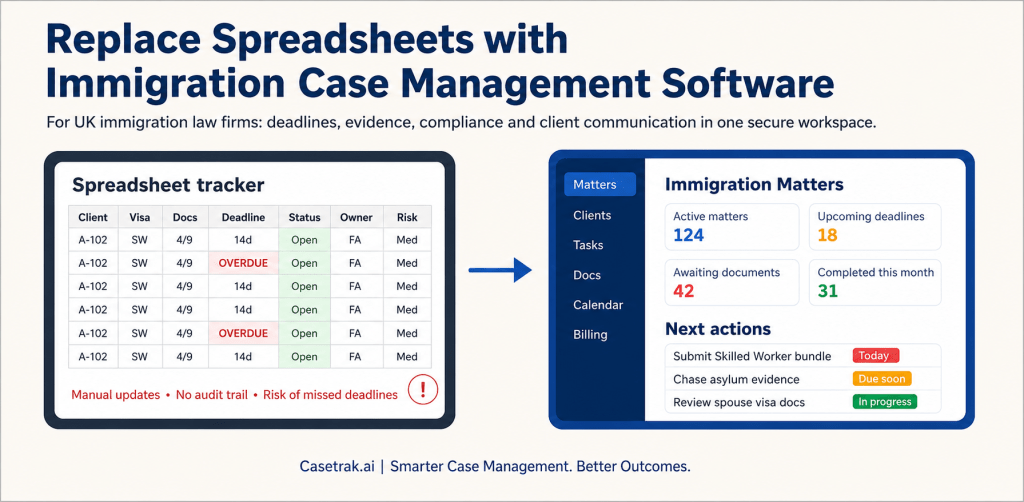
Introduction Immigration law is one of the most document-heavy, deadline-driven and compliance-sensitive areas of legal practice. Every matter – whether it involves a Skilled Worker visa, spouse visa, student visa, asylum claim, human rights appeal, settlement application, citizenship application, sponsor licence or judicial review – depends on accurate information, complete evidence, strict deadlines and clear client communication. Many UK immigration law firms still use spreadsheets to track their active caseload. At first, spreadsheets feel familiar and inexpensive. A shared workbook can list client names, visa categories, key dates, document status and matter owners. For a very small number of matters, this may appear workable. However, as soon as the firm grows, the spreadsheet becomes a risk. Immigration teams need more than rows and columns. They need a secure, auditable, workflow-driven system that can manage client intake, document collection, deadlines, Home Office correspondence, appeal dates, billing, supervision and reporting. This article explains why immigration law firms should replace spreadsheets with legal case management software and how Casetrak.ai can help firms work more efficiently and reduce operational risk. Why Spreadsheets Become a Problem in Immigration Practice Spreadsheets were designed for calculations and simple lists. They were not designed to manage sensitive legal matters. Immigration casework involves client vulnerability, large evidence bundles, strict Home Office or tribunal deadlines and changing matter stages. When firms rely on spreadsheet trackers, important information is often scattered across emails, shared folders, personal inboxes, calendar entries and handwritten notes. This creates a fragmented view of the matter. A fee earner may update a deadline in one place, while a paralegal stores evidence elsewhere and an accounts user separately records billing status. Unless everyone updates the same sheet consistently, the firm loses confidence in its own data. In a practice area where missing a date or document can have serious consequences for the client, that is not good enough. 1. Spreadsheets Increase the Risk of Missed Deadlines Immigration work is governed by time limits. Appeal deadlines, permission-to-appeal dates, biometric appointments, sponsor licence actions, visa expiry dates, Section 120 responses, evidence-submission dates and court directions all need careful monitoring. UK government guidance states, for example, that immigration and asylum tribunal appeals may involve 14-day or 28-day appeal windows depending on whether the applicant is inside or outside the UK. A spreadsheet can record these dates, but it cannot reliably manage them. It will not automatically escalate an overdue task, notify the supervising solicitor, link the deadline to the relevant document, or show whether the client has completed their part of the process. A single date typed incorrectly, hidden by a filter or missed during an update can lead to urgent remediation work, client dissatisfaction, reputational damage or potential negligence exposure. Legal case management software provides a more controlled environment. Deadlines can be linked to the matter, assigned to an owner, supported by reminders and visible to the wider team. 2. Spreadsheets Do Not Provide a Complete Matter History Immigration matters often develop over months or years. A client may move from a student visa to a graduate visa, then to a Skilled Worker visa, settlement and citizenship. Another client may have a refusal, appeal, fresh claim or human rights application. The firm needs to understand the complete history: previous applications, refusal reasons, evidence submitted, advice given, correspondence received and outstanding actions. A spreadsheet is rarely the full file. It may show a status such as ‘awaiting documents’ or ‘appeal submitted’, but it does not preserve the detailed chronology, communications, evidence, attendance notes and decisions behind that status. This becomes a problem when a matter is transferred between fee earners, reviewed by a supervisor or queried by the client. A legal case management platform allows the firm to maintain a single source of truth. The matter record can hold key dates, documents, tasks, notes, communications, billing and status information in one place. 3. Spreadsheets Make Document Collection Harder Immigration work depends heavily on evidence. Depending on the matter type, clients may need to provide passports, biometric residence permits, bank statements, payslips, tenancy agreements, relationship evidence, educational certificates, employer documents, business records, Home Office letters, refusal decisions, medical evidence or country evidence. In spreadsheet-led firms, document collection is often managed through long email chains. Staff update a column when a document is received, save attachments into separate folders and chase clients manually. This process is slow and error-prone. It can also create version-control issues, especially when clients send updated evidence or multiple documents with similar file names. A modern case management system, ideally connected to a secure client portal, can allow clients to upload documents directly against the matter. The system can show what has been received, what is still outstanding and which documents need review. This reduces email traffic and gives the team better visibility. 4. Spreadsheets Create Weak Audit Trails Law firms need to demonstrate how work was handled, who completed each task, when advice was given and how client information was protected. The Solicitors Regulation Authority expects solicitors and firms to protect client confidentiality and use technology in a way that enables compliance with the Code of Conduct. The ICO also expects organisations processing personal data to apply appropriate security, accountability and governance measures. Spreadsheets offer limited auditability. It may be difficult to see who changed a field, why a deadline moved or whether a client update was sent. Some cloud spreadsheet tools offer version history, but that is not the same as a matter-level audit trail designed for legal practice. Case management software can provide structured logs, task history, document records and controlled access. This is particularly important in immigration matters because the information is often highly sensitive and may include personal history, financial circumstances, medical information, family relationships and asylum-related evidence. 5. Spreadsheets Limit Supervision and Capacity Management Immigration teams often include solicitors, accredited caseworkers, paralegals, trainees and administrative staff. Supervisors need to understand matter progress, workloads, risk points and upcoming deadlines. A spreadsheet may provide a basic list, but it rarely gives real-time operational insight.
Data Retention Policies for Law Firms: What You Need to Know
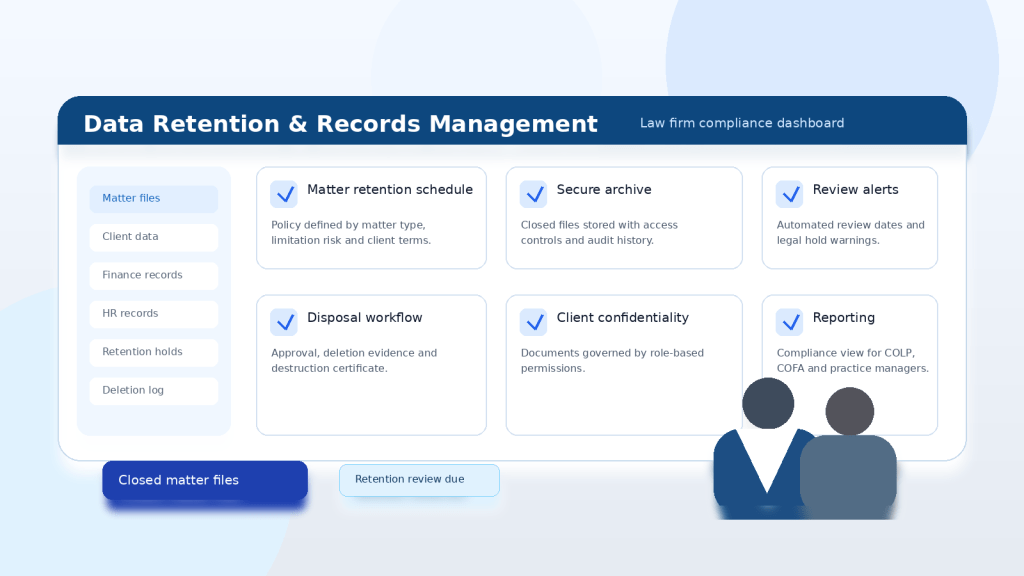
A practical UK-focused guide to retention schedules, client files, secure archiving and compliant records management Introduction Every law firm holds large volumes of sensitive information. Client files, correspondence, identity documents, financial records, court papers, contracts, employment records, billing data and internal notes may remain on systems long after the legal work has finished. Keeping records is necessary. Firms need evidence of instructions, advice, client-care information, billing history, accounting records and compliance decisions. They also need to defend potential claims, respond to regulatory enquiries and maintain continuity when staff change. However, keeping everything forever is not good practice. It increases cyber risk, complicates data subject requests, creates storage costs and may breach data protection principles. The ICO makes clear that personal data should not be kept for longer than necessary for the purpose for which it is processed. In practical terms, a law firm needs a defensible retention policy: one that explains what information is kept, why it is kept, how long it is kept, who can access it, and how it is securely deleted or archived. This article explains what a law firm data retention policy should cover, why it matters, common retention categories, and how technology such as Casetrak.ai can support a more consistent and auditable approach. Why Data Retention Matters for Law Firms Data retention is not just an administrative issue. It sits at the intersection of professional duties, data protection, risk management, client service, cyber security and operational efficiency. A weak retention approach can create several problems: ⦁ Closed files remain accessible to too many people.⦁ Personal data is kept without a clear purpose.⦁ Historic documents are difficult to locate when needed.⦁ Matter files are deleted before limitation or complaint risk has passed.⦁ Client-owned documents are destroyed without clear terms or consent.⦁ Staff do not know which records must be retained for accounting, AML or regulatory purposes.⦁ The firm cannot prove when and why data was deleted. For a modern law firm, the answer is not to delete aggressively or to keep everything indefinitely. The answer is a structured retention schedule supported by workflow, access control and audit history. The Legal and Regulatory Context UK data protection law is built around core principles. For retention, the most important is storage limitation. The principle requires personal data to be kept in a form that permits identification of individuals for no longer than is necessary for the purposes for which the data is processed. There is no single universal retention period for all law firm records. The correct period depends on the type of record, the nature of the matter, contractual terms, legal requirements, regulatory obligations and the risk profile of the work. Law firms should also consider professional duties of confidentiality. SRA guidance on confidentiality reminds firms that client information must be protected. Retention policies should therefore address both how long data is kept and how securely it is held during that period. There are also practical ownership issues. Some papers on a file may belong to the firm, while others may belong to the client. The SRA’s guidance on closing down a practice notes that firms often reserve the right to destroy a file after a specified time in their terms of business or agree this with the client at the end of the retainer. Accounting and company records also have specific retention expectations. GOV.UK guidance states that limited companies must generally keep records for six years from the end of the last company financial year to which they relate, with longer periods in certain circumstances. The key point is that a law firm should not use guesswork. It should document its retention decisions and apply them consistently. What Should a Law Firm Data Retention Policy Cover? A strong policy should be practical enough for staff to follow and detailed enough to satisfy management, compliance and data protection requirements. It should cover the following areas. Purpose and scope The policy should explain why the firm retains records and which systems and records are covered. This should include electronic files, paper files, emails, scanned documents, accounting records, client portal data, HR files, marketing records, AML documents and backups. Record categories Records should be grouped by type. A single retention period for every document is usually too blunt. Matter files, financial records, personnel files, unsuccessful job applications and marketing contacts may all require different treatment. Retention periods and trigger dates The policy should set out how long each record category is normally retained and when that period starts. For matter files, the trigger may be the date the matter is closed. For accounting records, it may be the end of the financial year. For recruitment data, it may be the end of the recruitment process. Legal holds and exceptions Destruction should be suspended where there is litigation, a complaint, regulatory investigation, dispute, audit, fraud concern or other reason to preserve records. A legal hold process prevents routine deletion from removing evidence that the firm may need. Access controls and secure disposal Closed files should not remain open to everyone by default. The policy should define who can access archived material and how paper and digital records are securely destroyed. It should also require evidence of deletion or destruction. Client terms and responsibilities The firm’s client-care documents and privacy notice should align with the retention policy. Clients should understand how long files are kept, what happens at the end of the retention period and how client-owned documents are handled. The policy should also identify process owners, such as the COLP, COFA, data protection lead, compliance manager, practice manager, department heads and IT team. Common Law Firm Record Categories Client and matter files These may include instructions, advice, drafts, correspondence, pleadings, contracts, transaction documents, court papers, attendance notes, settlement records, disclosure, evidence, experts’ reports and internal reviews. The appropriate retention period depends on the matter type. A simple advisory matter may not require the same retention period as a conveyancing transaction, trust matter, commercial contract, contentious dispute or matter involving
Client Portals for Family Law Firms: Improving Communication During Sensitive Cases

Family law is unlike any other area of legal practice. Clients approaching a family law firm are often experiencing some of the most stressful and emotionally challenging periods of their lives. Whether they are navigating divorce proceedings, child arrangements, financial disputes, domestic abuse matters, cohabitation disputes, or mediation processes, they require more than legal advice—they require reassurance, transparency, and effective communication. In many cases, the quality of communication between solicitor and client becomes just as important as the legal advice itself. Clients want answers. They want updates. They want visibility. And increasingly, they expect the same level of digital convenience they receive from banks, healthcare providers, insurers, and online retailers. Unfortunately, many law firms continue to rely heavily on emails, phone calls, paper correspondence, and disconnected systems to communicate with clients. These traditional methods create inefficiencies, increase administrative workloads, and often leave clients feeling frustrated or uncertain. This is where client portals are transforming the family law sector. A modern client portal provides a secure online environment where clients can access matter information, communicate with their legal team, upload documents, review tasks, and stay informed throughout their legal journey. In this article, we explore why client portals have become essential for modern family law firms and how Casetrak.ai helps firms deliver a superior client experience through secure digital engagement. The Communication Challenge in Family Law Communication is one of the most common sources of client dissatisfaction within family law matters. Clients often ask: While these questions are entirely reasonable, responding to them manually consumes significant time across the firm. For many family law practices: The result is frustration on both sides. A secure client portal solves many of these challenges by creating a centralised communication hub for the matter. Why Traditional Communication Methods Are No Longer Enough Email Limitations Email remains the primary communication method for many firms. However, email creates several challenges: Security Risks Sensitive personal information is frequently exchanged via email. This may include: Email can be forwarded, misplaced, or accessed by unintended recipients. Document Confusion Clients often struggle to identify: Information Fragmentation Matter information becomes scattered across: This makes it difficult to maintain a complete view of the matter. What Is a Family Law Client Portal? A client portal is a secure digital platform that allows law firms and clients to collaborate throughout the lifecycle of a legal matter. Think of it as a secure online workspace dedicated to each client and matter. Instead of relying on email chains and phone calls, clients can securely access information whenever they need it. The portal becomes a single source of truth for: Both the client and legal team benefit from greater transparency and efficiency. Why Family Law Firms Are Adopting Client Portals 1. Improved Client Experience Family law clients frequently feel anxious and uncertain. One of the biggest causes of anxiety is lack of visibility. A client portal provides: Clients feel more informed and engaged throughout the process. 2. Reduced Administrative Work Many client enquiries are repetitive. Examples include: A client portal allows clients to access information independently. This significantly reduces: 3. Faster Document Collection Document collection is one of the most time-consuming activities in family law. Clients may need to provide: A client portal enables clients to upload documents securely and directly into the matter workspace. This eliminates the need for multiple email exchanges. 4. Enhanced Security Family law matters involve highly confidential information. A secure client portal provides: This is significantly more secure than exchanging sensitive information through email. 5. Better Compliance and Governance Regulators increasingly expect firms to demonstrate appropriate controls around information management. Client portals support: Everything is stored in a centralised, searchable environment. Practical Family Law Use Cases Divorce Proceedings Divorce matters often involve substantial communication. Clients may need to: A client portal streamlines the entire process. Clients can: without waiting for emails or phone calls. Child Arrangement Matters Parents involved in child-related disputes often require ongoing communication and updates. A client portal provides: This improves transparency and reduces confusion. Financial Remedy Cases Financial remedy matters typically involve significant document collection. A portal enables: This accelerates the disclosure process and reduces administrative effort. Domestic Abuse Matters These cases often require heightened confidentiality and security. A secure portal provides: while reducing risks associated with email communications. How Casetrak.ai Client Portal Supports Family Law Firms Casetrak.ai has been designed specifically to help law firms modernise client engagement and streamline case management. Unlike standalone client portal solutions, the Casetrak.ai Client Portal is fully integrated with the wider practice management platform. This creates a seamless experience for both clients and legal professionals. Secure Client Access Clients can securely access: from a single location. No need for lengthy email chains or multiple systems. Integrated Document Management Clients can upload documents directly through the portal. Documents automatically become available within the matter workspace. Benefits include: Secure Messaging Casetrak.ai enables secure communication between clients and legal teams. Benefits include: Matter Status Tracking One of the most powerful features of a client portal is transparency. Clients can view: This reduces uncertainty and improves client confidence. Workflow Automation Casetrak.ai integrates portal activity with automated workflows. Examples include: This reduces administration while ensuring consistent service delivery. The Business Benefits for Family Law Firms Firms implementing client portals often experience: Improved Client Satisfaction Clients feel informed, supported, and connected throughout their matter. Reduced Administrative Costs Fewer phone calls, emails, and document-chasing activities. Greater Fee Earner Productivity Lawyers spend more time delivering legal advice and less time managing administration. Faster Matter Progression Information is exchanged more efficiently. Improved Compliance All interactions are securely stored and auditable. Competitive Differentiation A modern digital client experience helps firms stand out in a competitive legal market. The Future of Family Law Client Engagement Client expectations continue to evolve. Today’s clients expect: The firms that embrace digital client engagement will be best positioned to attract, retain, and serve clients effectively. Client portals are rapidly becoming a standard expectation rather than a premium feature. Conclusion Communication is at the heart of
Family Law Case Management: Essential Workflows Every Firm Should Automate

Introduction Family law is one of the most process-driven areas of legal practice. Whether handling divorce proceedings, child arrangement matters, financial settlements, domestic abuse applications, or mediation cases, legal teams follow many repeatable processes throughout the lifecycle of every matter. Yet many firms continue to manage these workflows using emails, spreadsheets, Outlook calendars, Word documents, and manual reminders. The result? ⦁ Valuable time lost on administration⦁ Increased risk of missed deadlines⦁ Inconsistent client experiences⦁ Reduced fee-earner productivity⦁ Lower profitability As family law firms face growing pressure to improve efficiency while maintaining exceptional client care, workflow automation has become a strategic necessity rather than a technology upgrade. Modern family law case management software enables firms to automate routine processes, standardise procedures, improve compliance, and create a better experience for both clients and staff. This article explores the essential workflows every family law firm should automate and how Casetrak.ai helps firms achieve operational excellence through intelligent case management. Why Workflow Automation Matters in Family Law Unlike many other practice areas, family law involves highly emotional client journeys. Clients expect: ⦁ Fast responses⦁ Regular updates⦁ Clear communication⦁ Accurate documentation⦁ Efficient handling of sensitive matters At the same time, firms must manage: ⦁ Court deadlines⦁ Financial disclosure requirements⦁ Client documentation⦁ Regulatory compliance⦁ Internal approvals⦁ Billing and reporting When these activities rely on manual administration, firms expose themselves to unnecessary risk and inefficiency. Workflow automation ensures that every matter follows a consistent and repeatable process while reducing the administrative burden placed on fee earners and support staff. Workflow 1: Client Intake and Matter Opening The Challenge Many family law firms still onboard new clients using: ⦁ Paper forms⦁ Email questionnaires⦁ Manual data entry⦁ Multiple spreadsheets This process often results in: ⦁ Duplicate information⦁ Delayed matter opening⦁ Missing documentation⦁ Administrative bottlenecks What Should Be Automated? Automated Client Intake The system should automatically: ⦁ Capture client information⦁ Create client records⦁ Generate matter files⦁ Trigger conflict checks⦁ Create onboarding tasks⦁ Assign responsible fee earners Benefits ⦁ Faster onboarding⦁ Reduced administration⦁ Improved client experience⦁ Greater consistency How Casetrak.ai Helps Casetrak.ai enables firms to standardise client onboarding workflows and automatically create matters, tasks, and records from a single process, reducing manual effort and accelerating matter commencement. Workflow 2: Divorce Case Management The Challenge Divorce matters often involve multiple stages: ⦁ Initial consultation⦁ Client engagement⦁ Financial disclosure⦁ Court applications⦁ Negotiations⦁ Consent orders⦁ Matter closure Managing these stages manually can result in missed activities and inconsistent processes. What Should Be Automated? Workflow Stages Automated workflows should: ⦁ Trigger tasks automatically⦁ Assign responsibilities⦁ Generate reminders⦁ Monitor progress⦁ Escalate overdue activities Benefits ⦁ Consistent case handling⦁ Improved visibility⦁ Better compliance⦁ Reduced risk How Casetrak.ai Helps Casetrak.ai allows firms to build structured matter workflows that guide staff through every stage of a divorce matter while automatically tracking progress and deadlines. Workflow 3: Financial Disclosure Management The Challenge Financial remedy cases often require significant document collection. Typical requests include: ⦁ Bank statements⦁ Tax returns⦁ Payslips⦁ Property information⦁ Investment details Chasing missing documents manually consumes substantial administrative time. What Should Be Automated? Document Collection Workflows The system should: ⦁ Request documents automatically⦁ Track outstanding items⦁ Send reminders⦁ Monitor completion status Benefits ⦁ Faster disclosure completion⦁ Reduced staff effort⦁ Better client accountability How Casetrak.ai Helps Casetrak.ai enables firms to track required documentation, automate follow-up activities, and provide clear visibility of outstanding items throughout the matter lifecycle. Workflow 4: Court Deadline Management The Challenge Family law matters contain numerous critical deadlines. Examples include: ⦁ Filing deadlines⦁ Court hearings⦁ Disclosure dates⦁ Mediation sessions⦁ Review meetings Missing a deadline can have serious consequences. What Should Be Automated? Deadline Monitoring The system should automatically: ⦁ Calculate deadlines⦁ Create tasks⦁ Generate reminders⦁ Escalate overdue actions Benefits ⦁ Reduced risk⦁ Improved compliance⦁ Greater accountability How Casetrak.ai Helps Casetrak.ai provides integrated task and deadline management that ensures important dates are tracked automatically and remain visible to the entire team. Workflow 5: Client Communication and Updates The Challenge Family law clients frequently request updates regarding: ⦁ Case progress⦁ Upcoming hearings⦁ Outstanding actions⦁ Documentation requirements Responding manually consumes significant fee-earner time. What Should Be Automated? Communication Workflows ⦁ Status updates⦁ Appointment reminders⦁ Document requests⦁ Matter milestones Benefits ⦁ Improved client satisfaction⦁ Reduced administrative effort⦁ Faster communication How Casetrak.ai Helps Casetrak.ai centralises client communication and enables firms to manage interactions efficiently while maintaining a complete matter history. Workflow 6: Document Generation The Challenge Family law firms repeatedly create similar documents. Examples include: ⦁ Engagement letters⦁ Court applications⦁ Disclosure requests⦁ Client correspondence⦁ Settlement documentation Manual document preparation increases workload and introduces risk. What Should Be Automated? The system should automatically populate documents using matter data. Benefits ⦁ Faster document creation⦁ Improved consistency⦁ Reduced errors How Casetrak.ai Helps Casetrak.ai integrates matter information with document templates, enabling firms to generate standard documents quickly and consistently. Workflow 7: Task Assignment and Team Collaboration The Challenge Many family law matters involve multiple individuals: ⦁ Solicitors⦁ Paralegals⦁ Legal assistants⦁ Administrative staff Without structured workflows, responsibilities become unclear. What Should Be Automated? Team-Based Workflow Management The system should: ⦁ Assign tasks automatically⦁ Track ownership⦁ Monitor completion⦁ Provide visibility Benefits ⦁ Improved collaboration⦁ Better accountability⦁ Faster matter progression How Casetrak.ai Helps Casetrak.ai provides centralised task management that keeps everyone aligned and ensures work is completed efficiently. Workflow 8: Time Recording and Billing The Challenge Delayed time recording remains a common issue in legal practices. Lost time entries directly impact revenue. What Should Be Automated? Financial Workflows Automated processes should support: ⦁ Time capture⦁ Billing approvals⦁ Invoice generation⦁ Payment tracking Benefits ⦁ Improved cash flow⦁ Increased profitability⦁ Reduced administration How Casetrak.ai Helps Casetrak.ai combines case management and financial management, helping firms capture billable activity accurately and streamline billing processes. Workflow 9: Matter Reviews and Compliance Checks The Challenge Compliance obligations require firms to perform regular reviews. These reviews are often forgotten when managed manually. What Should Be Automated? Review Workflows The system should: ⦁ Schedule reviews automatically⦁ Assign review tasks⦁ Capture outcomes⦁ Maintain audit trails Benefits ⦁ Stronger compliance⦁ Better governance⦁ Reduced risk How Casetrak.ai Helps
How Family Law Firms Can Reduce Administrative Work by 40%

Introduction Family law is one of the most demanding areas of legal practice. Solicitors and support staff must manage emotionally charged client relationships, strict court deadlines, extensive documentation, financial disclosures, correspondence, and ongoing case updates. While providing excellent legal advice remains the primary focus of every family law firm, many professionals spend a significant portion of their working day on administrative tasks rather than client work. Activities such as opening new matters, chasing documents, scheduling appointments, updating spreadsheets, preparing invoices, and tracking deadlines can consume countless hours each week. For many firms, administration has become an accepted cost of doing business. However, modern legal technology has fundamentally changed what is possible. With the right systems and processes, family law firms can reduce administrative workloads by as much as 40%, allowing fee earners to focus on higher-value activities that improve client outcomes and increase profitability. This article explores where administrative time is being lost, practical strategies for reducing it, and how Casetrak.ai helps family law firms streamline operations and work more efficiently. The Hidden Cost of Administration in Family Law Administrative work impacts more than productivity. Every hour spent on manual data entry, document management, or chasing information is an hour that cannot be spent advising clients, progressing cases, or generating revenue. Common consequences of excessive administration include: Many family law firms underestimate the amount of time spent on non-billable activities. When reviewed carefully, it is not uncommon for legal professionals to spend between 25% and 40% of their week on administration. The good news is that much of this work can now be automated or significantly streamlined. Where Family Law Firms Lose Administrative Time Manual Client Intake and Matter Creation The client onboarding process often involves multiple emails, forms, phone calls, and manual data entry. Information gathered from prospective clients is frequently entered into several systems, increasing the risk of errors and duplication. Typical challenges include: Each step may only take a few minutes, but across hundreds of matters per year, the administrative burden becomes substantial. Document Management Family law matters generate significant volumes of documentation, including: ⦁ Divorce petitions⦁ Financial disclosure forms⦁ Court applications⦁ Witness statements⦁ Correspondence⦁ Settlement agreements Without a centralised document management system, staff spend excessive time: ⦁ Searching for documents⦁ Managing email attachments⦁ Renaming files⦁ Organising folders⦁ Checking document versions Poor document management is one of the most common causes of inefficiency in legal practices. Tracking Deadlines and Key Dates Family law matters often involve numerous critical dates, including: ⦁ Court hearings⦁ Filing deadlines⦁ Disclosure requirements⦁ Mediation sessions⦁ Client meetings Many firms still rely on manual diary systems, spreadsheets, or Outlook reminders. These approaches increase the risk of missed deadlines and require significant administrative oversight. Client Communication Clients going through divorce, child custody disputes, or financial settlements often require frequent updates and reassurance. Lawyers and support staff spend substantial time: ⦁ Responding to status requests⦁ Sending updates⦁ Chasing information⦁ Scheduling appointments When communication processes are manual, administrative workloads increase significantly. Billing and Financial Administration Time recording and billing remain essential but often create additional administrative overhead. Common issues include: ⦁ Delayed time entry⦁ Missing billable activity⦁ Invoice preparation⦁ Payment tracking⦁ Financial reporting Manual billing processes not only consume time but can negatively impact cash flow. Five Practical Ways to Reduce Administrative Work by 40% Automate Client Intake The first opportunity for efficiency begins before a matter is opened.Modern legal practice management systems can automate: ⦁ Client questionnaires⦁ Matter creation⦁ Workflow initiation⦁ Document generation⦁ Task assignment Instead of manually creating records and folders, firms can standardise and automate the process. Benefits include: ⦁ Faster onboarding⦁ Improved client experience⦁ Reduced data entry⦁ Greater consistency Centralise Matter Information One of the biggest causes of inefficiency is having information stored across multiple systems. Family law firms should aim to maintain a single source of truth for: ⦁ Client details⦁ Matter information⦁ Correspondence⦁ Documents⦁ Tasks⦁ Notes⦁ Financial data When all information is accessible from one location, staff spend less time searching and more time progressing matters. Implement Workflow Automation Many family law matters follow predictable processes. For example: ⦁ Divorce proceedings⦁ Financial remedy applications⦁ Child arrangements cases⦁ Consent orders Workflow automation enables firms to create repeatable processes that automatically generate: ⦁ Tasks⦁ Reminders⦁ Deadlines⦁ Notifications⦁ Document templates This reduces reliance on memory and manual administration while ensuring consistency across the firm. Improve Document Management A modern document management approach can save significant amounts of time. Best practices include: ⦁ Centralised document storage⦁ Matter-based filing⦁ Version control⦁ Secure access management⦁ Fast search functionality By eliminating document duplication and reducing search time, firms can improve productivity immediately. Streamline Billing and Reporting Administrative teams often spend hours preparing invoices and compiling management reports. Integrated legal practice management systems allow firms to: ⦁ Capture time automatically⦁ Generate invoices quickly⦁ Monitor work in progress⦁ Track profitability⦁ Produce management reports This reduces administration while providing greater financial visibility. How Casetrak.ai Helps Family Law Firms Reduce Administrative Work Casetrak.ai has been designed to help modern law firms streamline operations, improve productivity, and enhance client service. By bringing together matter management, workflows, documents, communication, and financial information into a single platform, Casetrak.ai enables family law firms to significantly reduce administrative overhead. Centralised Matter Management Casetrak.ai provides a complete view of every matter from a single location. Users can access: ⦁ Client information⦁ Matter history⦁ Documents⦁ Tasks⦁ Notes⦁ Financial data This eliminates the need to switch between multiple systems and reduces time spent searching for information. Workflow Automation Family law firms can automate repeatable processes and ensure consistency across all matters. Automated workflows can: ⦁ Create tasks automatically⦁ Trigger reminders⦁ Assign responsibilities⦁ Track progress⦁ Support compliance requirements This reduces manual administration while helping teams stay organised. Document Management Casetrak.ai enables firms to store and manage documents securely within the context of each matter. Benefits include: ⦁ Improved document organisation⦁ Faster retrieval⦁ Better collaboration⦁ Reduced duplication⦁ Enhanced security Staff spend less time managing files and more time delivering legal services. Task and Deadline Management Critical deadlines can be tracked automatically
10 Ways Law Firms Can Simplify Time Tracking and Improve Billing Accuracy

For lawyers, time is revenue. Every six-minute unit of chargeable work that is not recorded is fee income that the firm will never recover. Time recording remains one of the most persistent operational challenges in legal practice. Many firms still rely on memory-based reconstruction, spreadsheets, or end-of-day batch entry—methods that routinely result in: The challenge is not simply recording time—it is recording it consistently, accurately, and contemporaneously. Modern legal technology has substantially improved this process, making it practical for practitioners to capture every chargeable unit without materially disrupting their working pattern. Why Law Firm Time Tracking Often Fails The majority of time recording failures share a single root cause: delay. When practitioners postpone recording time, they are forced to reconstruct their activity from: Reconstruction is inherently imprecise—it results in under-recording, inconsistent entries, and billing figures that clients can legitimately challenge. Manual recording systems—paper logs, spreadsheets, dictated notes—compound the problem by requiring duplicate entry, manual correction, and significant administrative time to maintain. Firms that rely on these systems consistently spend more resource managing time records than the process warrants. Why Digital Time Tracking Matters Digital time recording addresses these problems by: Law firm benchmarking data consistently demonstrates that practitioners using manual recording methods under-capture a significant proportion of their chargeable time. Structured digital time recording systems enable firms to recover that revenue and operate more efficiently without increasing headcount. 10 Effective Ways to Track Lawyer Time More Efficiently Modern legal practice management software provides a range of flexible recording methods to ensure no chargeable work goes uncaptured. Below are ten practical approaches. Use a Live Timer While Working A real-time timer is the most accurate method of time recording available. Activating a timer when commencing work and pausing it when stopping eliminates the need to estimate or reconstruct time entries after the fact. Why it works: A running timer records every unit of work in real time—ensuring chargeable activity is captured as it occurs, without interrupting the practitioner’s focus. Record Time After Completing Work Where real-time recording is not practicable, contemporaneous logging immediately after completing a task is the next best approach. Best practice: This approach balances operational flexibility against the discipline of accurate time recording. End-of-day batch logging is preferable to next-day reconstruction, though real-time recording remains the most accurate method. Track Time on Mobile Devices Solicitors spend a significant proportion of working time away from the office—at court, in client meetings, or travelling between sites. Mobile time recording ensures chargeable work is captured wherever it occurs. Benefits: Immediate mobile recording eliminates the risk of forgetting chargeable activities that occur outside the office environment. Convert Calendar Events into Time Entries Most practitioners maintain detailed calendars, yet calendar events are rarely converted into time entries. This is a straightforward source of recoverable billing. Why it helps: Calendar-to-billing integration is particularly valuable on meeting-heavy days, where individual time reconstruction at the end of the day is most likely to produce inaccurate results. Turn Tasks into Billable Time Entries Task management tools that integrate with a practice management platform can function simultaneously as time recording systems. Advantages: Linking time entries directly to tasks ensures that all chargeable activity is captured against the correct matter and that team productivity is visible to supervisors and management. Track Time Directly from Email Email correspondence is one of the most significant sources of chargeable but under-recorded time in legal practice. Short email exchanges add up materially over a working week. Why this matters: Email-integrated time recording allows practitioners to log chargeable email time directly from their inbox, without switching to a separate application—reducing friction and improving capture rates. Use Passive Time Tracking Tools Passive time recording tools capture work activity automatically in the background, without requiring the practitioner to initiate or maintain manual entries. Benefits: At the end of the working day, practitioners review the automatically generated activity log, confirm or adjust the captured entries, and convert them to billable time—reducing total time recording effort while improving completeness. Log Time Using Voice Commands Voice-enabled time recording is increasingly available in legal software, allowing hands-free entry without interrupting ongoing work. How it helps: Practitioners must, however, give careful consideration to client confidentiality when using voice recording tools—particularly in shared or public environments. Compliance with data protection obligations and the SRA’s confidentiality rules is required. Use Text or Quick Notes for Time Logging Quick-note or text-based time recording allows practitioners to capture activity as it occurs with minimal friction—ideal for short tasks where opening a formal time entry form would be disproportionate. Benefits: These entries are subsequently reviewed, supplemented with narrative, and converted into formal time records linked to the relevant matter. Automate Time Capture from Device Activity Advanced automated capture tools analyse device and application activity logs to identify billable work that would otherwise go unrecorded—without any manual input from the practitioner. What it does: Automated capture maximises accuracy and completeness with minimal manual effort—it is particularly effective for practitioners who find manual time recording discipline difficult to maintain. Why Better Time Tracking Improves Law Firm Profitability Efficient time recording is not merely an administrative improvement—it has a direct and measurable impact on firm revenue and profitability. Better tracking leads to: When every chargeable unit is captured accurately, a firm’s revenue increases without any corresponding increase in the volume of work being done. Final Thoughts Time recording does not need to be a burden. With the right combination of tools and structured habits, law firms can transition from manual, error-prone processes to automated, integrated systems that capture chargeable time accurately and with minimal practitioner effort. The cumulative effect—across a full working year—is a material increase in recoverable fees and a substantially reduced administrative overhead.
Client Relationship Management for Law Firms: 5 Proven Strategies for Growth

Client relationships are the foundation of every successful law firm. A practice’s ability to attract, communicate with, and retain clients directly determines its long-term viability and growth. In a competitive legal market, winning a new instruction is only the beginning. The greater challenge—and the greater differentiator—is building lasting trust, maintaining consistent communication, and delivering perceptible value throughout every stage of the client relationship. This article sets out five practical strategies to strengthen client relationships and support sustainable firm growth. Why Client Relationships Matter in Law Effective client relationships are built on trust, reliability, and the client’s perception that the firm genuinely understands and advances their interests. Clients who feel heard and supported are more likely to: ● Return for future legal services ● Recommend your firm to others ● Leave positive reviews and referrals ● Stay loyal even in competitive markets Conversely, poor communication, unresponsiveness, or a lack of transparency can quickly damage a firm’s reputation—often irreparably—and erode revenue through lost referrals and non-returning clients. Communicate Proactively (Don’t Wait to Be Asked) Proactive communication is one of the most effective—and most commonly neglected—practices in legal client management. Clients do not want silence. When they are not hearing from their solicitor, many assume their matter is not progressing. A brief update—even one noting that nothing material has changed—provides reassurance and demonstrates active engagement with their matter. Why it matters: How to improve it: Use automated email or SMS updates through a legal CRM platform to ensure clients receive timely, consistent communication at every defined stage of their matter. Build a Strong Local and Professional Reputation For most law firms, reputation is the most powerful driver of new business—often exceeding any marketing spend. Clients choose solicitors based on: Why it matters: Clients are more likely to instruct solicitors who are known, credible, and seen as authoritative within their community or professional network. How to improve it: Focus on Understanding Client Needs Every client arrives with different expectations, priorities, and degrees of urgency. Treating all clients identically leads to a generic service that few will experience as genuinely attentive. The most effective practitioners combine legal expertise with active listening—understanding not just the legal issue but the client’s underlying concern, risk tolerance, and desired outcome. Why it matters: Best practice: A simple but powerful intake question—”What outcome matters most to you in this situation?”—opens a conversation that aligns expectations from the outset and demonstrates genuine interest in the client’s goals. Clearly Demonstrate Your Value Many clients have limited visibility into what legal work actually entails. Without that understanding, fees can appear disproportionate and the value of the service unclear. The solicitor’s role is to bridge that gap—not by justifying fees after the fact, but by helping clients understand the scope, complexity, and risk implications of their matter throughout the process. Why it matters: Where clients cannot perceive the value of legal work, they will evaluate the relationship solely on cost—which is an unfavourable basis for any professional service. How to improve it: When clients understand what the firm is doing on their behalf, the professional and financial stakes involved, and the risks being managed, the perception of value increases—and pricing becomes less of a friction point. Show Commitment to Helping, Not Just Billing Clients remain loyal to firms they perceive as genuinely committed to achieving the best possible outcome for them. A relationship that feels purely transactional—responsive only to instructions, generating no proactive advice—is easily replaced. Why it matters: Clients who feel their solicitor is genuinely invested in the outcome—not just processing their instruction—are significantly more likely to return, refer others, and respond constructively when problems arise. How to demonstrate it: A client who feels that the firm is working with them—not merely for them—is far more likely to remain loyal through the duration of the matter and beyond. Key Takeaways To build strong and lasting client relationships, firms should focus on: Final Thoughts Client relationship management is not a one-off effort—it is an ongoing discipline that directly determines a firm’s growth trajectory and long-term reputation. In a competitive legal market, firms that prioritise communication, transparency, and genuine client engagement will consistently outperform those that do not. Strong client relationships do not just retain existing clients—they generate referrals, attract new instructions, and build the foundation on which a resilient practice is built.
5 Tips to Improve Law Firm Client Relationships

Strong client relationships are the foundation of sustainable law firm growth. Winning new instructions matters—but retaining existing clients, generating referrals, and maintaining long-term loyalty depends on how well firms communicate, manage expectations, and deliver consistently throughout the matter lifecycle. The practical challenge is real: when juggling deadlines, filings, court preparation, and client queries simultaneously, proactive relationship management is easily deprioritised. A structured approach to client communication—supported by the right practice management platform—is what separates firms that retain clients from those that lose them to competitors. CaseTrak’s Matter Management module helps firms centralise communications, automate updates, and maintain visibility across every active matter. Below are five practical strategies to strengthen client relationships and build long-term loyalty. Client relationships and law firm growth Satisfied clients do not just return for future legal needs—they refer others, leave positive reviews, and become long-term advocates. Client relationship quality directly drives firm revenue and reputation. Client expectations have risen significantly. Clients now expect transparency, responsiveness, and clarity throughout every stage of their matter—not just at the outset. Client feedback data consistently shows that communication and predictability are valued as highly as legal expertise. Firms must focus not only on the quality of the legal work, but also on how clearly and consistently they keep clients informed throughout each matter. Structured matter management is critical in this context—it enables firms to track updates, assign responsibilities, and ensure no client is left without a timely response. 1. Communicate proactively across every matter Proactive communication is among the most effective—and underused—client retention tools available to law firms. Clients should not have to chase their lawyers for updates. When clients are not hearing from the firm, they frequently assume their matter is stalled or being neglected. Rather than waiting for clients to ask, firms should: CaseTrak’s Matter Management module enables teams to standardise communication workflows so that updates are automatically triggered when a matter progresses between defined stages. This eliminates the risk of communication gaps and reduces manual effort. The result is fewer unsolicited follow-up calls, less client anxiety, greater transparency, and stronger long-term trust. 2. Build and protect your firm’s reputation Most clients choose a law firm based, at least in part, on its reputation. For most practices, reputation is built through: Reputation is also built—or damaged—during active matters. A well-handled file, with clear communication and structured updates, does more for a firm’s standing than any marketing investment. A structured matter management system ensures every client receives consistent, professional service regardless of which fee earner is handling their matter. 3. Take a holistic approach to client needs Clients do not categorise their problems as legal practitioners do. A client instructing the firm on one issue may have related needs across other practice areas. Firms that identify these connections and respond proactively build deeper and more durable client relationships. Rather than treating each matter in isolation, firms should develop the habit of: CaseTrak’s Matter Management module provides a unified view of all matters associated with a client, enabling the firm to understand the full context and coordinate service across practice areas. 4. Demonstrate value through visibility and clarity Legal fees are only perceived as fair when clients understand the work behind them. Legal work is often invisible to clients—not because it is unimportant, but because it is not communicated in terms they can appreciate. Firms can bridge this gap by: When clients can clearly see what is happening in their matter, trust increases and billing disputes decrease. CaseTrak’s matter management tools create structured visibility—turning complex legal work into clear, trackable progress that clients can follow and understand. 5. Stay focused on client concerns throughout the matter lifecycle Every client has a primary concern driving their matter—whether cost, timing, risk, or a specific outcome. Understanding and consistently addressing that concern is central to effective client relationship management. Firms can demonstrate this commitment by: With a centralised matter management system, client priorities can be recorded at the outset and referenced at every stage, ensuring that every team member remains aligned on what matters most to the client—regardless of who is handling the matter at any given point. Key takeaways Strong client relationships are built deliberately—through consistent communication, structured processes, and clear visibility across every matter. In summary: Implemented consistently and supported by a structured platform like CaseTrak, these practices do not just improve individual client relationships—they create a more efficient, scalable, and client-focused firm that is better positioned for sustainable growth.