
How Immigration Law Firms Can Reduce Administrative Work in Visa and Asylum Matters
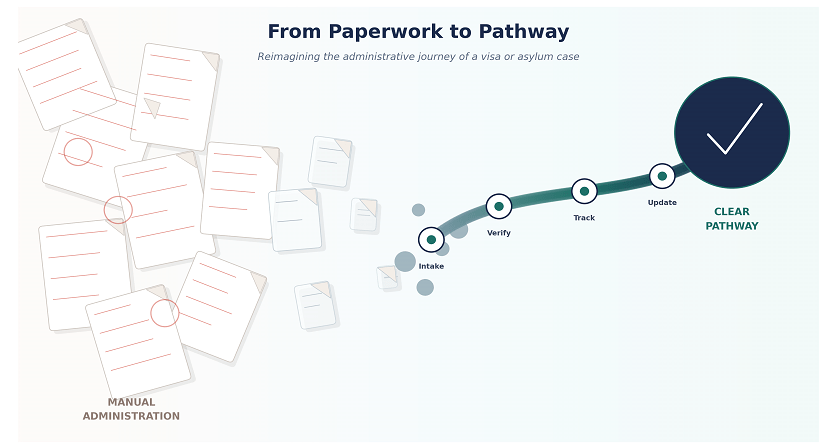
Visa and asylum casework has never generated more paperwork per fee-earner hour. The shift to digital eVisas, a still-substantial asylum appeals backlog, and tightening margins on fixed-fee and legal aid work all add administrative load at exactly the moment firms need fee-earners spending more time on legal judgment, not data entry. This article sets out where that administrative burden actually comes from in UK immigration practice and the concrete steps firms can take to reduce it — without compromising the regulatory obligations that come with the work.
Why Administrative Burden Is Rising Across UK Immigration Practice
Three structural changes are driving up non-billable administrative time in immigration teams right now.
The end of physical immigration documents
The Home Office has phased out Biometric Residence Permits and visa vignettes in favour of digital eVisas, accessed through a UK Visas and Immigration (UKVI) account and proven to third parties using time-limited share codes. Firms holding expired BRPs or BRCs for clients can still use them to link a UKVI account, but only until 31 December 2026, after which the physical document is no longer accepted for that purpose. That deadline, combined with a parallel rollout of Electronic Travel Authorisations and automated carrier checks from February 2026, means immigration teams are now fielding a steady stream of account-recovery, share-code and “why was my client refused boarding” queries that did not exist five years ago.
A falling but still heavy asylum caseload
The headline numbers look like progress: 48,758 people were waiting for an initial asylum decision at the end of March 2026, down 55% on the previous year, and the legacy pre-2022 backlog has been almost entirely cleared. But the appeals backlog tells a different story — it reached 87,450 cases at the end of March 2026, up 72% year-on-year, with an average wait of 67 weeks to clear an appeal. For firms running asylum and appeals caseloads, this means less time spent waiting for a first decision and considerably more time spent on tribunal bundles, status-tracking and client communication during long appeal waits — work that does not always map neatly onto fixed fees or legal aid rates.
Processing times that vary by route, and rarely improve in a straight line
Standard work and study visa applications from outside the UK are typically decided within three weeks, while in-country switching or extension applications carry an eight-week standard, spouse and family applications run to eight to twelve weeks depending on whether they are made in or out of country, and ILR applications can take anywhere from eight to twenty-six weeks. Every one of those bands sits alongside a paid priority (£500) or super-priority (£1,000) upgrade, which is itself a recurring client conversation and a billing and consent process in its own right. The practical effect for a firm running a mixed caseload is a constant, low-level administrative task: knowing which service standard applies to which file, and whether a particular case has genuinely overrun it or is simply within a wide “normal” range.
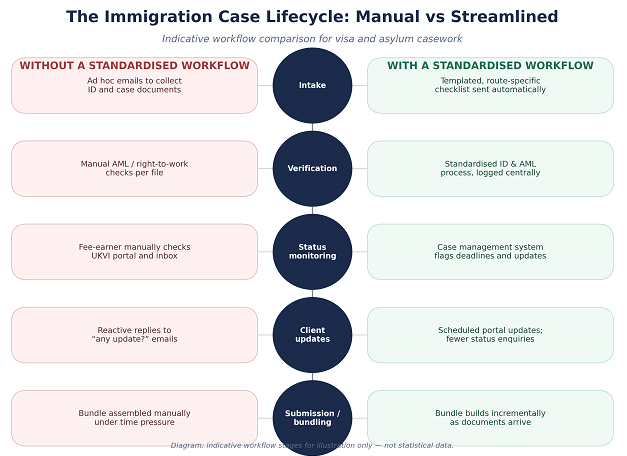
Figure 2: Where a standardised workflow changes the shape of a typical case, stage by stage.
Where the Time Actually Goes
Before fixing the problem, it helps to be specific about which stages of a file generate the most avoidable administrative work. In most immigration teams, it clusters around five points in the case lifecycle.
⦁ Client onboarding and ID verification: collecting identity documents, running anti-money-laundering and right-to-work checks, and opening the file in a way that satisfies both SRA and OISC-equivalent obligations.
⦁ Document collection and chasing: repeated email and phone follow-up for payslips, bank statements, relationship evidence or country-of-origin material.
⦁ Status monitoring: manually checking the UKVI portal, tracking biometric appointments, and watching for Home Office correspondence that can arrive with very short response windows.
⦁ Client correspondence: answering “any update?” enquiries that, in a well-run file, should be pre-empted by scheduled updates rather than reactive replies.
⦁ Bundling and submission: assembling evidence bundles for applications, administrative review or tribunal appeals, often compressed into the days before a deadline rather than built incrementally.
Practical Ways to Reduce Administrative Work
1. Standardise intake with route-specific checklists
A single generic “please send your documents” email is the single biggest driver of repeat chasing. Building a short library of checklists — one per visa route, kept current as the Immigration Rules change — and sending the right one automatically at instruction stage removes a large share of back-and-forth before it starts. The checklist should specify format (PDF, not photos of paper), naming convention and an upload mechanism, not just a list of document types.
2. Centralise the file in a proper case management system
Spreadsheets and shared inboxes do not scale past a handful of files per fee-earner. A case or practice management platform that supports automated deadline calculation, document assembly and audit-trail logging turns status monitoring from a manual daily check into something the system surfaces for you. Most UK firms now run this through one of the established legal case management platforms used across the sector, configured with workflow templates specific to visa and asylum work rather than generic litigation templates.
3. Give clients a portal instead of an inbox
A significant proportion of inbound client email is a status enquiry that a self-service portal would answer without fee-earner involvement. Scheduled automatic updates at defined milestones — application submitted, biometrics booked, decision received — reduce the volume of reactive correspondence and improve the client’s experience of a process they otherwise cannot see into.
4. Delegate by task, not by file
Splitting each file into discrete tasks — document verification, bundle assembly, correspondence drafting, substantive legal advice — and allocating them to the appropriately qualified team member (caseworker, paralegal, solicitor) keeps routine administrative work off fee-earner time without compromising supervision. This requires clear escalation rules so that anything touching legal judgment, risk assessment or client advice is reviewed by a qualified solicitor before it leaves the file.
5. Build a written, compliant AI and automation policy
Generative AI tools can usefully draft first-pass correspondence, summarise long Home Office bundles or triage incoming documents, but the SRA has been explicit that professional responsibility cannot be delegated to a tool. Its Risk Outlook on AI in the legal market sets out the core risks — accuracy, bias, confidentiality, accountability — and recent cases have shown the consequences of skipping verification: in Ayinde v Hackney and Al-Haroun v Qatar National Bank, the Divisional Court held that an unverified language model is not capable of reliable legal research, and a separate wasted-costs order described the failure to check AI-generated citations as a failure of firm management rather than an individual lapse. A workable policy should name a senior individual or COLP with oversight of AI use, restrict which tools can receive client data and on what contractual basis, and require human verification of any AI-assisted output before it reaches a client or the Home Office.
6. Get ahead of the eVisa transition rather than reacting to it
Proactively setting up and linking UKVI accounts for clients at the start of a matter, rather than waiting for a right-to-work or right-to-rent check to fail, avoids a disproportionate amount of urgent, unbillable firefighting later in the file. This is particularly relevant before the 31 December 2026 cut-off for using expired physical documents to link an account.
7. Triage Home Office correspondence against the published service standards
Knowing the current service standard for each route — and checking it before escalating — stops fee-earners spending time chasing decisions that are still within a normal range, while flagging the genuinely overdue files that justify a complaint, an MP enquiry or a pre-action letter.
Balancing Efficiency With Regulatory and Ethical Obligations
None of the above is a substitute for the SRA Principles that already govern the work: competence, confidentiality and acting in the client’s best interests apply identically whether a task is done by a person or assisted by software. Practically, that means three things for any efficiency programme:
- Client data sent to any third-party platform — case management, AI or otherwise — must be assessed for confidentiality and data protection compliance before adoption, not after.
- Automation should be confined to genuinely administrative tasks; legal analysis, risk assessment and client advice remain the responsibility of a supervising solicitor.
- Firms regulated by the SRA, and individuals operating under OISC accreditation where relevant, should document who is accountable for each tool and process, so that oversight survives staff turnover.
Measuring Whether It Is Actually Working
Efficiency initiatives are easy to launch and hard to evaluate without the right baseline. Useful, trackable measures include:
Efficiency initiatives are easy to launch and hard to evaluate without the right baseline. Useful, trackable measures include:
- Average number of chasing emails or calls per file, from instruction to first substantive Home Office response.
- Fee-earner hours per file split between billable legal work and administrative tasks.
- Proportion of files where a deadline (biometric appointment, evidence submission, appeal window) was missed or required a last-minute scramble.
- Client complaints or negative feedback specifically referencing communication or delay.
None of these require sophisticated analytics — a case management system that logs task type and time is normally sufficient to start tracking them.
Conclusion
Administrative work in visa and asylum practice has grown for reasons outside any individual firm’s control: a digital-only immigration status system, a large appeals backlog running at well over a year’s wait, and processing times that vary widely by route. The firms managing it best are not necessarily working harder — they have standardised intake, moved status tracking and routine correspondence into systems rather than inboxes, delegated by task with clear supervision, and built AI use into a documented compliance framework rather than leaving it to individual habit. That combination protects fee-earner time for the legal judgment that actually requires it, which is, in the end, the only part of the job a system cannot do.
Frequently Asked Questions
Is it compliant for a UK immigration firm to use AI tools on client files?
Yes, subject to the same SRA Principles that apply to any other tool: the firm must assess confidentiality and data protection risk before sending client data to a third-party AI platform, and a solicitor must verify any AI-assisted output before it is relied on or sent to a client or the Home Office. The SRA has stated that professional responsibility cannot be transferred to an AI system.
What is the deadline for clients still using an expired BRP or BRC?
Expired Biometric Residence Permits and Biometric Residence Cards can be used to create or link a UKVI account until 31 December 2026. After that date, clients without a linked eVisa account may struggle to prove their immigration status to employers, landlords and other checking bodies.
How long should a typical visa application take?
It depends entirely on the route: standard work and study visas from outside the UK are usually decided within three weeks, in-country switching or extension applications within eight weeks, spouse and family applications within eight to twelve weeks, and ILR applications within eight to twenty-six weeks. These are service standards, not guarantees, and individual cases can run longer.