Introduction
Immigration law is one of the most document-heavy, deadline-driven and client-sensitive areas of legal practice in the UK. Every matter – whether it concerns a Skilled Worker visa, sponsor licence, spouse or partner visa, asylum claim, human rights application, student visa, settlement application or immigration appeal – involves strict evidential requirements, detailed client instructions, Home Office correspondence, forms, fees, deadlines and ongoing communication.
For a busy immigration law firm, managing this work through spreadsheets, shared folders and email inboxes quickly becomes difficult. A single missed appeal deadline, lost refusal letter, incomplete evidence bundle or unrecorded client instruction can have serious consequences for the client and the firm.
Professional immigration case management software gives firms a single, secure and structured platform to manage each matter from first enquiry to final outcome. It helps fee earners reduce administration, improve visibility, standardise workflows and give clients a more professional service.
This article explains the essential features every UK immigration law firm should look for when selecting case management software and how a modern platform such as Casetrak.ai can support immigration teams in practice.
Why Immigration Law Firms Need Specialist Case Management Software
Generic office tools were not designed for the realities of immigration work. Immigration matters combine legal advice, client care, regulatory duties, multi-stage evidence collection, Home Office portals, tribunal deadlines and sensitive personal data. A firm may be managing hundreds of live matters at different stages, each with its own documents, dates, tasks and risk profile.
The problem is not only volume. Immigration clients may be under significant personal pressure because their work, family life, education, status or safety depends on the outcome of the matter. They often need regular reassurance and clear instructions about what is required next. When communication is slow or fragmented, clients lose confidence and firms spend more time answering avoidable status queries.
Specialist case management software solves these problems by giving lawyers, paralegals and support teams a shared operational system. Instead of relying on individual memory, inboxes or spreadsheet trackers, everyone can see the status of a matter, outstanding documents, upcoming deadlines and next actions.
Essential Feature 1: Centralised Matter and Client Management
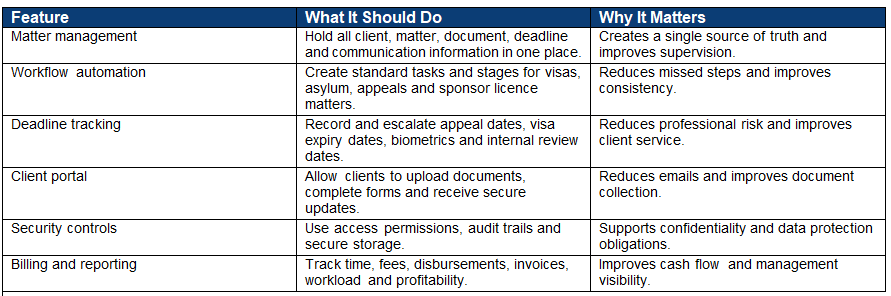
The foundation of any immigration case management system is a centralised client and matter record. Each matter should hold all key information in one place, including client details, immigration category, matter stage, Home Office reference numbers, linked parties, assigned fee earners, key dates, documents, tasks, notes and financial information.
This is particularly important in immigration law because one client may have several related matters over time. For example, a client may start with a Skilled Worker visa, later apply for dependant visas for family members, then apply for indefinite leave to remain and eventually citizenship. A good system should help the firm maintain continuity across the client journey.
Centralisation also improves supervision. Partners and managers can review workload, check high-risk matters and identify delays without requesting manual updates from each fee earner.
Essential Feature 2: Structured Immigration Workflows
Immigration matters follow repeatable stages, even though every client’s facts are different. A strong system should allow firms to create workflow templates for common matter types, such as spouse visas, Skilled Worker applications, sponsor licence applications, asylum claims, administrative reviews and tribunal appeals.
Each workflow can include standard tasks, responsible owners, document checklists, internal review points and deadline reminders. This helps junior staff follow the correct process and reduces the risk of missing important steps.
For example, a spouse visa workflow may include initial eligibility review, client-care documentation, relationship evidence, financial evidence, accommodation evidence, English-language evidence, application drafting, client review, submission, biometrics, outcome tracking and post-decision advice. An asylum appeal workflow will require a very different process, including refusal review, appeal deadline calculation, evidence gathering, witness statements, bundle preparation and hearing management.
Essential Feature 3: Deadline and Calendar Management
Deadline management is one of the most important requirements for immigration firms. Appeal and review deadlines can be short and unforgiving. GOV.UK guidance explains that immigration and asylum tribunal appeal timing can differ depending on whether the appellant is inside or outside the UK, with 14-day and 28-day timeframes applying in common appeal scenarios.
A case management system should help firms record and monitor deadlines centrally, with reminders, escalation rules and visibility across the team. It should support court and tribunal dates, Home Office response dates, biometric appointments, sponsor licence renewal dates, visa expiry dates, right-to-work follow-up dates and internal review deadlines.
The system should not replace professional judgement. Fee earners must still check the relevant decision letter, procedural rules and client circumstances. However, once a deadline is verified, the system should make it difficult for that date to be missed.
Essential Feature 4: Document Collection and Evidence Management
Immigration practice depends on evidence. Firms regularly request passports, BRPs or eVisas, refusal letters, payslips, bank statements, tenancy agreements, employment letters, sponsor documents, relationship evidence, educational records, medical records and witness statements.
Without a structured system, evidence collection quickly becomes chaotic. Documents may arrive by email, WhatsApp, post or file-share link. They may be misnamed, duplicated, incomplete or saved in the wrong folder.
Effective immigration case management software should support secure document upload, document checklists, document categories, version control, missing-evidence tracking and matter-based storage. It should also allow the firm to see which documents have been requested, received, reviewed and approved.
This is a major area where Casetrak.ai can help. By connecting document requests, client portal uploads and matter records, firms can reduce the time spent chasing attachments and manually saving files.
Essential Feature 5: Secure Client Portal
A client portal is increasingly important for immigration firms. Clients need a safe and simple way to upload documents, complete questionnaires, receive updates and communicate with their legal team.
A secure portal is preferable to relying entirely on email attachments, especially where documents contain sensitive personal, financial, employment, family or protection-related information. The SRA provides guidance on solicitors’ obligations around keeping client information confidential, and firms should ensure their technology choices support those duties.
A good immigration client portal should allow clients to view matter status, see outstanding tasks, upload evidence, receive secure messages, access key documents and receive notifications. This improves client experience and reduces administrative pressure on the firm.
Casetrak.ai’s client portal can support this model by giving clients a modern, secure and matter-linked way to collaborate with the firm.
Essential Feature 6: Forms, Questionnaires and Intake Automation
Immigration work requires detailed information. If this information is collected informally, fee earners may spend hours retyping information into systems, forms or advice notes.
Modern case management software should support structured intake forms and client questionnaires. These can capture personal details, immigration history, family members, travel history, employment details, previous applications, refusal history and document availability.
The benefit is not only speed. Structured intake improves consistency, reduces missing information and creates a better audit trail. It also allows the firm to identify urgent issues earlier, such as visa expiry, appeal deadlines, safeguarding concerns or potential overstaying risk.
Essential Feature 7: Communication History and Matter Notes
Immigration matters often involve frequent communication with clients, the Home Office, employers, sponsors, experts, interpreters and representatives. A good system should keep emails, notes, calls and secure portal messages linked to the matter record.
This helps the firm answer basic questions quickly: what was agreed, what evidence was requested, what advice was given, what the client confirmed and what remains outstanding. It also supports supervision and continuity if a matter is transferred between fee earners.
Essential Feature 8: Compliance, Security and Audit Trails
Immigration law firms hold highly sensitive personal data. This can include passport details, immigration status, family relationships, bank details, medical records, employment information and details of asylum or human rights claims.
The ICO advises organisations to store, share and dispose of information responsibly and to keep people’s details secure. In practice, firms should look for technology that supports access controls, secure authentication, audit trails, role-based permissions, reliable backups and responsible data retention.
A case management system should make it clear who accessed or changed information, when documents were uploaded, when tasks were completed and when important communications were sent. This helps with internal governance, complaints handling and regulatory confidence.
Essential Feature 9: Time Recording, Billing and Financial Visibility
Many immigration matters are handled on fixed fees, staged fees or mixed billing arrangements. Even where the client is charged a fixed fee, the firm still needs to understand how much time is being spent and whether the matter is profitable.
Case management software should allow fee earners to record time, track disbursements, manage staged billing, monitor unpaid invoices and analyse profitability by matter type. This gives management better visibility of which work is sustainable and where processes may need improvement.
For example, if spouse visa matters consistently take more time than expected because evidence collection is slow, the firm may need better intake forms, clearer document checklists or automated reminders.
Essential Feature 10: Reporting and Dashboards
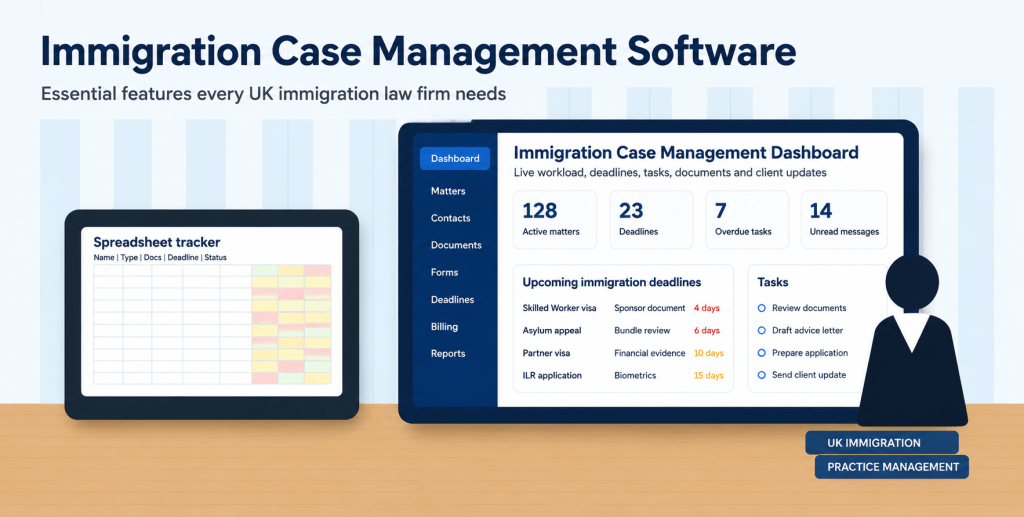
Partners and practice managers need real-time information. Useful dashboards for an immigration law firm may show active matters, new enquiries, deadlines in the next 7 or 14 days, overdue tasks, matters waiting for client documents, matters awaiting Home Office decisions, billing status and fee-earner workload.
Reporting turns case management software from a filing system into a management tool. It helps the firm plan capacity, reduce bottlenecks, improve client service and make better commercial decisions.
Essential Feature 11: Search, Templates and Knowledge Reuse
Immigration firms repeatedly create similar documents and correspondence. Software should support templates for engagement letters, document request letters, attendance notes, submission letters, client updates and matter closure letters.
Fast search is equally important. When a client calls about a Home Office email, a missing document or a previous application, staff should be able to locate the information quickly without searching multiple inboxes and folders.
Essential Feature 12: Scalability for Growing Firms
A system that works for a sole practitioner should also support growth into a team of lawyers, paralegals, consultants and administrative staff. Scalability means more than adding users. It means consistent workflows, secure access, team visibility, reporting, supervision and the ability to handle higher matter volumes without administrative chaos.
Casetrak.ai is well placed for firms that want to move away from manual systems and build a more scalable operating model for immigration practice.
How Casetrak.ai Can Help UK Immigration Law Firms
Casetrak.ai can support immigration firms by bringing matter management, workflows, document handling, client communication, task tracking, billing and reporting into one connected platform.
For immigration firms, this means:
⦁ A single source of truth for each client and matter
⦁ Structured workflows for different immigration case types
⦁ Secure document collection through a client portal
⦁ Task and deadline visibility across the team
⦁ Matter-linked communication history
⦁ Better supervision and compliance records
⦁ Integrated time recording, billing and reporting
⦁ Improved client experience and reduced administrative burden
The real value of a platform such as Casetrak.ai is not simply replacing spreadsheets. It helps the firm operate with more control, consistency and confidence. Every matter becomes easier to track, every team member knows what needs to happen next, and clients receive a more professional service.
Implementation Tips for Immigration Firms
Replacing spreadsheets should be managed as an operational improvement project rather than a simple software purchase. Firms should start by mapping their most common matter types and identifying the pain points that create the greatest risk or administrative burden.
- List your main immigration matter types and current process steps.
- Identify deadlines, document checklists and client communications that should be standardised.
- Create workflow templates for high-volume work such as partner visas, Skilled Worker matters and appeals.
- Agree user roles, access permissions and supervision responsibilities.
- Migrate active matters carefully, starting with key dates and documents.
- Train fee earners and support staff using real matter scenarios.
- Review performance after implementation and refine workflows based on user feedback.
The best results come when software reflects the way the firm actually works while also improving consistency and reducing unnecessary manual effort.
Conclusion
Immigration law firms operate in a demanding environment. They must manage complex rules, sensitive client information, detailed evidence requirements and strict deadlines while delivering clear communication and commercial efficiency.
Spreadsheets and disconnected tools may work at the very beginning of a practice, but they quickly become a source of risk as the firm grows. Immigration case management software gives firms the structure, visibility and control needed to manage matters professionally.
The essential features include centralised matter management, immigration-specific workflows, deadline tracking, secure document collection, client portals, intake automation, communication history, compliance controls, billing, reporting and scalable team management.
Casetrak.ai can help UK immigration law firms modernise their operations, reduce administrative burden, improve client service and build a more efficient practice. For firms serious about growth and compliance, legal case management software is no longer optional – it is a core part of modern immigration practice.
Frequently Asked Questions
What is immigration case management software?
Immigration case management software is a legal technology platform that helps immigration law firms manage clients, matters, documents, deadlines, workflows, communications, billing and reporting from one secure system.
Why should immigration law firms stop using spreadsheets?
Spreadsheets are not designed for legal matter management. They do not provide secure document handling, workflow automation, audit trails, deadline escalation, client portals or integrated billing. This creates risk and inefficiency as caseloads grow.
What features matter most for immigration lawyers?
The most important features include client and matter management, deadline tracking, document checklists, secure client portals, workflow automation, communication history, compliance controls, billing and real-time reporting.
Can case management software help with immigration appeals?
Yes. It can help track appeal deadlines, refusal decisions, grounds of appeal, evidence bundles, hearing dates, tasks and client communications. Solicitors must still verify applicable deadlines and provide legal advice.
How can Casetrak.ai support immigration firms?
Casetrak.ai can help firms manage immigration matters through centralised records, workflows, secure client collaboration, document management, task tracking, billing and reporting, supporting a more organised and professional practice.
Quick Feature Checklist for UK Immigration Law Firms