
Introduction
Immigration law is one of the most document-heavy, deadline-driven and compliance-sensitive areas of legal practice. Every matter – whether it involves a Skilled Worker visa, spouse visa, student visa, asylum claim, human rights appeal, settlement application, citizenship application, sponsor licence or judicial review – depends on accurate information, complete evidence, strict deadlines and clear client communication.
Many UK immigration law firms still use spreadsheets to track their active caseload. At first, spreadsheets feel familiar and inexpensive. A shared workbook can list client names, visa categories, key dates, document status and matter owners. For a very small number of matters, this may appear workable.
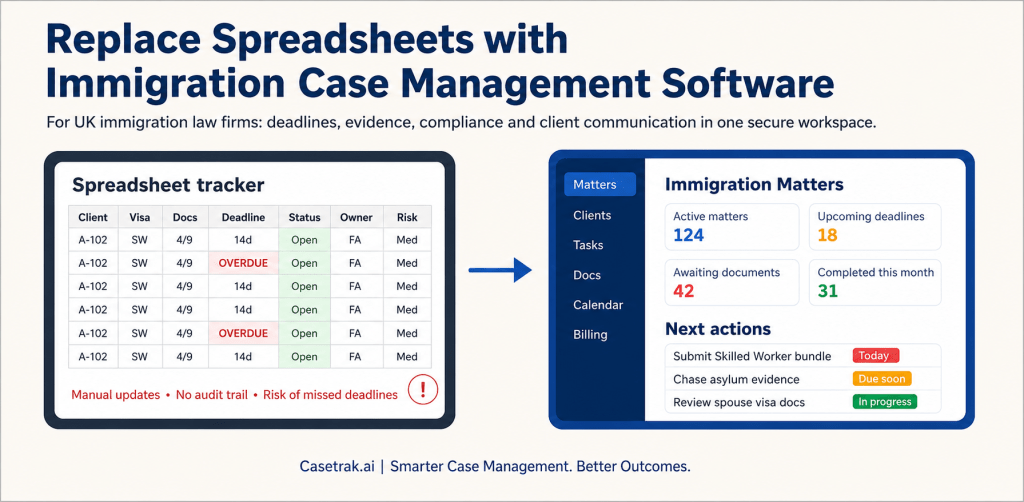
However, as soon as the firm grows, the spreadsheet becomes a risk. Immigration teams need more than rows and columns. They need a secure, auditable, workflow-driven system that can manage client intake, document collection, deadlines, Home Office correspondence, appeal dates, billing, supervision and reporting. This article explains why immigration law firms should replace spreadsheets with legal case management software and how Casetrak.ai can help firms work more efficiently and reduce operational risk.
Why Spreadsheets Become a Problem in Immigration Practice
Spreadsheets were designed for calculations and simple lists. They were not designed to manage sensitive legal matters. Immigration casework involves client vulnerability, large evidence bundles, strict Home Office or tribunal deadlines and changing matter stages. When firms rely on spreadsheet trackers, important information is often scattered across emails, shared folders, personal inboxes, calendar entries and handwritten notes.
This creates a fragmented view of the matter. A fee earner may update a deadline in one place, while a paralegal stores evidence elsewhere and an accounts user separately records billing status. Unless everyone updates the same sheet consistently, the firm loses confidence in its own data. In a practice area where missing a date or document can have serious consequences for the client, that is not good enough.
1. Spreadsheets Increase the Risk of Missed Deadlines
Immigration work is governed by time limits. Appeal deadlines, permission-to-appeal dates, biometric appointments, sponsor licence actions, visa expiry dates, Section 120 responses, evidence-submission dates and court directions all need careful monitoring. UK government guidance states, for example, that immigration and asylum tribunal appeals may involve 14-day or 28-day appeal windows depending on whether the applicant is inside or outside the UK.
A spreadsheet can record these dates, but it cannot reliably manage them. It will not automatically escalate an overdue task, notify the supervising solicitor, link the deadline to the relevant document, or show whether the client has completed their part of the process. A single date typed incorrectly, hidden by a filter or missed during an update can lead to urgent remediation work, client dissatisfaction, reputational damage or potential negligence exposure.
Legal case management software provides a more controlled environment. Deadlines can be linked to the matter, assigned to an owner, supported by reminders and visible to the wider team.
2. Spreadsheets Do Not Provide a Complete Matter History
Immigration matters often develop over months or years. A client may move from a student visa to a graduate visa, then to a Skilled Worker visa, settlement and citizenship. Another client may have a refusal, appeal, fresh claim or human rights application. The firm needs to understand the complete history: previous applications, refusal reasons, evidence submitted, advice given, correspondence received and outstanding actions.
A spreadsheet is rarely the full file. It may show a status such as ‘awaiting documents’ or ‘appeal submitted’, but it does not preserve the detailed chronology, communications, evidence, attendance notes and decisions behind that status. This becomes a problem when a matter is transferred between fee earners, reviewed by a supervisor or queried by the client.
A legal case management platform allows the firm to maintain a single source of truth. The matter record can hold key dates, documents, tasks, notes, communications, billing and status information in one place.
3. Spreadsheets Make Document Collection Harder
Immigration work depends heavily on evidence. Depending on the matter type, clients may need to provide passports, biometric residence permits, bank statements, payslips, tenancy agreements, relationship evidence, educational certificates, employer documents, business records, Home Office letters, refusal decisions, medical evidence or country evidence.
In spreadsheet-led firms, document collection is often managed through long email chains. Staff update a column when a document is received, save attachments into separate folders and chase clients manually. This process is slow and error-prone. It can also create version-control issues, especially when clients send updated evidence or multiple documents with similar file names.
A modern case management system, ideally connected to a secure client portal, can allow clients to upload documents directly against the matter. The system can show what has been received, what is still outstanding and which documents need review. This reduces email traffic and gives the team better visibility.
4. Spreadsheets Create Weak Audit Trails
Law firms need to demonstrate how work was handled, who completed each task, when advice was given and how client information was protected. The Solicitors Regulation Authority expects solicitors and firms to protect client confidentiality and use technology in a way that enables compliance with the Code of Conduct. The ICO also expects organisations processing personal data to apply appropriate security, accountability and governance measures.
Spreadsheets offer limited auditability. It may be difficult to see who changed a field, why a deadline moved or whether a client update was sent. Some cloud spreadsheet tools offer version history, but that is not the same as a matter-level audit trail designed for legal practice.
Case management software can provide structured logs, task history, document records and controlled access. This is particularly important in immigration matters because the information is often highly sensitive and may include personal history, financial circumstances, medical information, family relationships and asylum-related evidence.
5. Spreadsheets Limit Supervision and Capacity Management
Immigration teams often include solicitors, accredited caseworkers, paralegals, trainees and administrative staff. Supervisors need to understand matter progress, workloads, risk points and upcoming deadlines. A spreadsheet may provide a basic list, but it rarely gives real-time operational insight.
Questions such as ‘Which appeals are due this week?’, ‘Which asylum matters are awaiting evidence?’, ‘Which sponsor licence files have no recent activity?’ or ‘Which fee earner is overloaded?’ are difficult to answer confidently from a manual tracker.
Legal case management software can provide dashboards and reports showing matter status, overdue tasks, approaching deadlines, work allocation and financial information. This helps managers supervise proactively rather than discovering issues after they have become urgent.
6. Spreadsheets Are Poor for Client Communication
Immigration clients are often anxious. Their immigration status may affect their employment, education, family life, housing, ability to travel or safety. They want to know what is happening, what documents are required, whether the application has been submitted and what happens next.
Where the firm relies on spreadsheets, client updates tend to depend on manual emails and telephone calls. Staff spend time answering routine questions that could have been avoided with better visibility.
A client portal can give clients a secure way to view requests, upload documents, receive notifications and communicate with the legal team. This does not replace personal legal advice, but it reduces repetitive administration and improves client confidence.
7. Spreadsheets Do Not Scale Well
A spreadsheet may work for 20 matters. It becomes fragile at 200 matters and risky at 2,000. As immigration practices grow, they need repeatable workflows, standard checklists, role-based access, document templates, billing integration and management reporting.
Spreadsheets encourage workarounds. Firms add more tabs, colour codes, comments, hidden columns and formulas. Over time, only one or two people understand how the tracker really works. If those people are unavailable, the firm becomes exposed.
Legal case management software is designed to scale. It allows the firm to standardise matter types, workflows, document categories, client tasks and reporting without depending on a fragile manual tracker.
Common Immigration Workflows That Should Move Out of Spreadsheets
Immigration firms should consider replacing spreadsheet tracking across the full matter lifecycle. Key workflows include: client enquiry and eligibility screening; conflict and compliance checks; matter opening; document checklist generation; evidence collection; application preparation; internal review; submission tracking; biometric appointment tracking; Home Office correspondence; refusal review; appeal deadline tracking; bundle preparation; hearing management; billing; payment tracking; and post-decision follow-up.
Each of these workflows contains steps, owners, documents and dates. Managing them through a spreadsheet creates unnecessary risk. Managing them through a legal case management system creates visibility, accountability and consistency.
What Legal Case Management Software Should Provide for Immigration Firms
The right system for an immigration law firm should include more than a simple contact database. It should provide matter management, document management, task workflows, deadline tracking, client communication, reporting and billing.
Important features include:
⦁ Matter templates for common immigration case types
⦁ Visa-expiry and appeal-deadline tracking
⦁ Secure document upload and evidence management
⦁ Client questionnaires and checklists
⦁ Task ownership and escalation
⦁ Integrated notes and correspondence history
⦁ Case-stage visibility
⦁ Billing and payment tracking
⦁ Reporting for supervision and management
⦁ Role-based access controls
⦁ Audit trails
⦁ Cloud access for hybrid working
The aim is not simply to digitise the spreadsheet. The aim is to redesign the process so that immigration matters are easier to manage, supervise and complete.
How Casetrak.ai Can Help Immigration Law Firms
Casetrak.ai can help immigration law firms replace spreadsheet-led case tracking with a connected legal case management platform. Instead of relying on separate trackers, inboxes and folders, firms can manage clients, matters, documents, tasks, dates, communications, billing and reporting from a central system.
For immigration teams, this can support a more organised approach to visa applications, asylum matters, appeals, sponsor licence work, settlement applications and citizenship matters. Each case type can have its own workflow, checklist and key milestones. Staff can see what needs to be done, who owns each task and which deadlines are approaching.
Centralised Matter Management
Casetrak.ai provides a structured matter workspace where the team can maintain core information about the client, matter type, case stage, responsible fee earner, documents, notes, dates, tasks and billing. This helps reduce the fragmentation caused by spreadsheets and email folders.
Workflow Automation
Immigration firms can use workflows to standardise repeatable processes. For example, a spouse visa workflow may include relationship evidence, financial requirement documents, accommodation evidence, English-language evidence, application drafting, review and submission. An asylum workflow may include client intake, statement preparation, evidence collection, interview preparation, Home Office correspondence and appeal review.
By automating task creation and reminders, firms can reduce the need for manual spreadsheet updates.
Secure Document Management and Client Portal
Casetrak.ai can support secure document handling through structured matter records and client collaboration. Clients can be guided to provide the correct evidence, while staff can track what has been received and what remains outstanding. This is especially valuable in immigration matters where incomplete evidence can delay applications or weaken submissions.
Better Deadline and Task Visibility
Instead of relying on colour-coded spreadsheet cells, teams can manage deadlines through matter tasks, reminders and dashboards. Supervisors can see overdue work and approaching milestones. Fee earners can prioritise tasks more effectively. Administrative staff can chase outstanding items with greater confidence.
Billing, Reporting and Profitability
Immigration law firms need to understand not only case progress but also profitability, fee arrangements, billing status and unpaid amounts. A connected system can help link matter activity with time recording, billing and reporting. This supports better financial control than a spreadsheet that only tracks operational status.
A Practical Migration Plan: From Spreadsheet to System
Moving away from spreadsheets should be planned carefully. Firms do not need to change everything overnight. A sensible migration plan could include:
- Identify the most important spreadsheet trackers currently in use.
- Map the matter types and stages used by the immigration team.
- List key dates, tasks, documents and reports required for each case type.
- Standardise naming conventions and data fields.
- Build workflows for the highest-volume matters first.
- Import active matters into the new system.
- Train staff on new processes and responsibilities.
- Run a short parallel period for validation.
- Retire spreadsheet trackers once confidence is established.
- Review reports and refine workflows after the first month.
The most successful projects are not technology-only exercises. They are operational improvement projects supported by technology.
Conclusion
Spreadsheets may feel familiar, but they are no longer the right foundation for a modern immigration law practice. Immigration firms manage sensitive client information, strict deadlines, complex evidence requirements, ongoing client communication and high regulatory expectations. A manual tracker cannot provide the control, visibility and auditability required for sustainable growth.
Legal case management software helps firms reduce risk, improve efficiency, strengthen supervision, streamline document collection and deliver a more professional client experience. For immigration law firms handling visa applications, appeals, asylum claims, sponsor licence work and settlement matters, the move away from spreadsheets is not just a technology upgrade. It is a practical step towards better client service and stronger operational management.
Casetrak.ai can support this transition by giving immigration law firms a central platform for matter management, workflows, documents, deadlines, client communication, billing and reporting. With the right system in place, firms can spend less time updating spreadsheets and more time delivering high-quality legal advice.
Frequently Asked Questions
Q: Why are spreadsheets risky for immigration law firms?
A: Spreadsheets can be difficult to control, audit and supervise. They are vulnerable to manual errors, missed updates, version confusion and incomplete visibility across the team.
Q: What is immigration case management software?
A: It is a legal practice platform that helps immigration firms manage clients, matters, documents, tasks, deadlines, correspondence, billing and reporting in one structured system.
Q: Can legal case management software help with appeal deadlines?
A: Yes. A good system can help record deadlines, assign tasks, generate reminders and make upcoming dates visible to the relevant team members. The legal team must still verify the correct deadline.
Q: How does a client portal help immigration clients?
A: A secure portal allows clients to upload documents, complete forms, receive messages and view requests without relying only on email attachments and telephone calls.
Q: How can Casetrak.ai help immigration firms replace spreadsheets?
A: Casetrak.ai provides matter management, workflows, task tracking, document management, client collaboration, billing and reporting in a single platform, helping firms reduce spreadsheet dependency and improve operational control.
Call to Action
Ready to replace spreadsheet-led immigration matter tracking? Book a personalised Casetrak.ai demonstration and see how your firm can manage immigration matters with greater clarity, security and control.
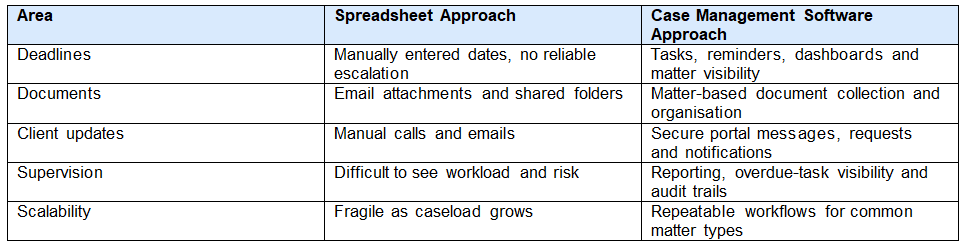
Spreadsheet vs Legal Case Management Software
References
⦁ GOV.UK – Appeal against a visa or immigration decision:
https://www.gov.uk/immigration-asylum-tribunal/appeal-decision-online
⦁ SRA – Confidentiality of client information:
https://www.sra.org.uk/solicitors/guidance/confidentiality-client-information
⦁ SRA – Compliance tips for solicitors regarding technology/AI:
https://www.sra.org.uk/solicitors/resources/innovate/compliance-tips-for-solicitors
⦁ ICO – UK GDPR guidance and resources:
https://ico.org.uk/for-organisations/uk-gdpr-guidance-and-resources
⦁ ICO – Security including cyber security:
https://ico.org.uk/for-organisations/uk-gdpr-guidance-and-resources/security/