
Data Retention Policies for Law Firms: What You Need to Know
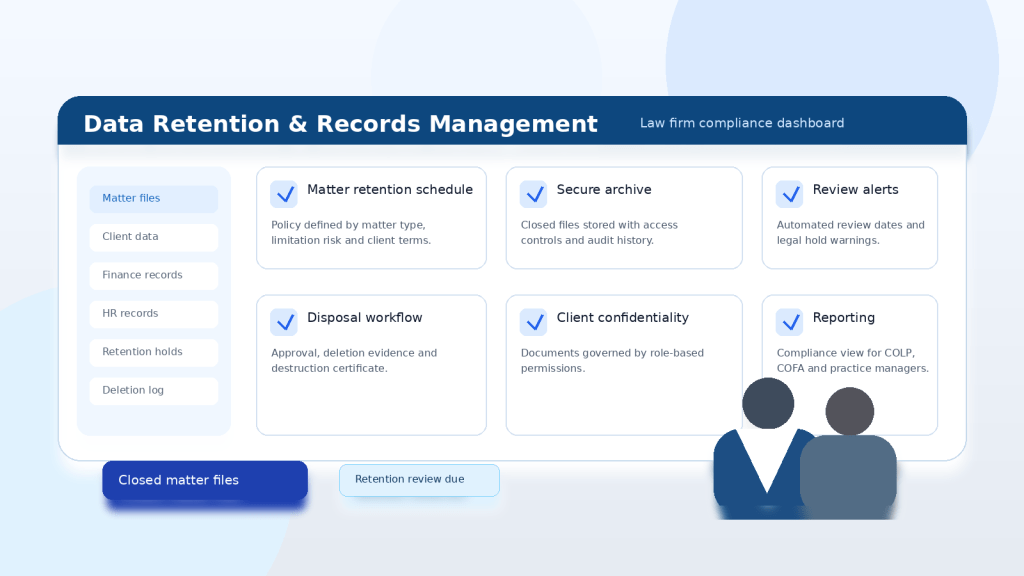
A practical UK-focused guide to retention schedules, client files, secure archiving and compliant records management Introduction Every law firm holds large volumes of sensitive information. Client files, correspondence, identity documents, financial records, court papers, contracts, employment records, billing data and internal notes may remain on systems long after the legal work has finished. Keeping records is necessary. Firms need evidence of instructions, advice, client-care information, billing history, accounting records and compliance decisions. They also need to defend potential claims, respond to regulatory enquiries and maintain continuity when staff change. However, keeping everything forever is not good practice. It increases cyber risk, complicates data subject requests, creates storage costs and may breach data protection principles. The ICO makes clear that personal data should not be kept for longer than necessary for the purpose for which it is processed. In practical terms, a law firm needs a defensible retention policy: one that explains what information is kept, why it is kept, how long it is kept, who can access it, and how it is securely deleted or archived. This article explains what a law firm data retention policy should cover, why it matters, common retention categories, and how technology such as Casetrak.ai can support a more consistent and auditable approach. Why Data Retention Matters for Law Firms Data retention is not just an administrative issue. It sits at the intersection of professional duties, data protection, risk management, client service, cyber security and operational efficiency. A weak retention approach can create several problems: ⦁ Closed files remain accessible to too many people.⦁ Personal data is kept without a clear purpose.⦁ Historic documents are difficult to locate when needed.⦁ Matter files are deleted before limitation or complaint risk has passed.⦁ Client-owned documents are destroyed without clear terms or consent.⦁ Staff do not know which records must be retained for accounting, AML or regulatory purposes.⦁ The firm cannot prove when and why data was deleted. For a modern law firm, the answer is not to delete aggressively or to keep everything indefinitely. The answer is a structured retention schedule supported by workflow, access control and audit history. The Legal and Regulatory Context UK data protection law is built around core principles. For retention, the most important is storage limitation. The principle requires personal data to be kept in a form that permits identification of individuals for no longer than is necessary for the purposes for which the data is processed. There is no single universal retention period for all law firm records. The correct period depends on the type of record, the nature of the matter, contractual terms, legal requirements, regulatory obligations and the risk profile of the work. Law firms should also consider professional duties of confidentiality. SRA guidance on confidentiality reminds firms that client information must be protected. Retention policies should therefore address both how long data is kept and how securely it is held during that period. There are also practical ownership issues. Some papers on a file may belong to the firm, while others may belong to the client. The SRA’s guidance on closing down a practice notes that firms often reserve the right to destroy a file after a specified time in their terms of business or agree this with the client at the end of the retainer. Accounting and company records also have specific retention expectations. GOV.UK guidance states that limited companies must generally keep records for six years from the end of the last company financial year to which they relate, with longer periods in certain circumstances. The key point is that a law firm should not use guesswork. It should document its retention decisions and apply them consistently. What Should a Law Firm Data Retention Policy Cover? A strong policy should be practical enough for staff to follow and detailed enough to satisfy management, compliance and data protection requirements. It should cover the following areas. Purpose and scope The policy should explain why the firm retains records and which systems and records are covered. This should include electronic files, paper files, emails, scanned documents, accounting records, client portal data, HR files, marketing records, AML documents and backups. Record categories Records should be grouped by type. A single retention period for every document is usually too blunt. Matter files, financial records, personnel files, unsuccessful job applications and marketing contacts may all require different treatment. Retention periods and trigger dates The policy should set out how long each record category is normally retained and when that period starts. For matter files, the trigger may be the date the matter is closed. For accounting records, it may be the end of the financial year. For recruitment data, it may be the end of the recruitment process. Legal holds and exceptions Destruction should be suspended where there is litigation, a complaint, regulatory investigation, dispute, audit, fraud concern or other reason to preserve records. A legal hold process prevents routine deletion from removing evidence that the firm may need. Access controls and secure disposal Closed files should not remain open to everyone by default. The policy should define who can access archived material and how paper and digital records are securely destroyed. It should also require evidence of deletion or destruction. Client terms and responsibilities The firm’s client-care documents and privacy notice should align with the retention policy. Clients should understand how long files are kept, what happens at the end of the retention period and how client-owned documents are handled. The policy should also identify process owners, such as the COLP, COFA, data protection lead, compliance manager, practice manager, department heads and IT team. Common Law Firm Record Categories Client and matter files These may include instructions, advice, drafts, correspondence, pleadings, contracts, transaction documents, court papers, attendance notes, settlement records, disclosure, evidence, experts’ reports and internal reviews. The appropriate retention period depends on the matter type. A simple advisory matter may not require the same retention period as a conveyancing transaction, trust matter, commercial contract, contentious dispute or matter involving
Client Portals for Family Law Firms: Improving Communication During Sensitive Cases

Family law is unlike any other area of legal practice. Clients approaching a family law firm are often experiencing some of the most stressful and emotionally challenging periods of their lives. Whether they are navigating divorce proceedings, child arrangements, financial disputes, domestic abuse matters, cohabitation disputes, or mediation processes, they require more than legal advice—they require reassurance, transparency, and effective communication. In many cases, the quality of communication between solicitor and client becomes just as important as the legal advice itself. Clients want answers. They want updates. They want visibility. And increasingly, they expect the same level of digital convenience they receive from banks, healthcare providers, insurers, and online retailers. Unfortunately, many law firms continue to rely heavily on emails, phone calls, paper correspondence, and disconnected systems to communicate with clients. These traditional methods create inefficiencies, increase administrative workloads, and often leave clients feeling frustrated or uncertain. This is where client portals are transforming the family law sector. A modern client portal provides a secure online environment where clients can access matter information, communicate with their legal team, upload documents, review tasks, and stay informed throughout their legal journey. In this article, we explore why client portals have become essential for modern family law firms and how Casetrak.ai helps firms deliver a superior client experience through secure digital engagement. The Communication Challenge in Family Law Communication is one of the most common sources of client dissatisfaction within family law matters. Clients often ask: While these questions are entirely reasonable, responding to them manually consumes significant time across the firm. For many family law practices: The result is frustration on both sides. A secure client portal solves many of these challenges by creating a centralised communication hub for the matter. Why Traditional Communication Methods Are No Longer Enough Email Limitations Email remains the primary communication method for many firms. However, email creates several challenges: Security Risks Sensitive personal information is frequently exchanged via email. This may include: Email can be forwarded, misplaced, or accessed by unintended recipients. Document Confusion Clients often struggle to identify: Information Fragmentation Matter information becomes scattered across: This makes it difficult to maintain a complete view of the matter. What Is a Family Law Client Portal? A client portal is a secure digital platform that allows law firms and clients to collaborate throughout the lifecycle of a legal matter. Think of it as a secure online workspace dedicated to each client and matter. Instead of relying on email chains and phone calls, clients can securely access information whenever they need it. The portal becomes a single source of truth for: Both the client and legal team benefit from greater transparency and efficiency. Why Family Law Firms Are Adopting Client Portals 1. Improved Client Experience Family law clients frequently feel anxious and uncertain. One of the biggest causes of anxiety is lack of visibility. A client portal provides: Clients feel more informed and engaged throughout the process. 2. Reduced Administrative Work Many client enquiries are repetitive. Examples include: A client portal allows clients to access information independently. This significantly reduces: 3. Faster Document Collection Document collection is one of the most time-consuming activities in family law. Clients may need to provide: A client portal enables clients to upload documents securely and directly into the matter workspace. This eliminates the need for multiple email exchanges. 4. Enhanced Security Family law matters involve highly confidential information. A secure client portal provides: This is significantly more secure than exchanging sensitive information through email. 5. Better Compliance and Governance Regulators increasingly expect firms to demonstrate appropriate controls around information management. Client portals support: Everything is stored in a centralised, searchable environment. Practical Family Law Use Cases Divorce Proceedings Divorce matters often involve substantial communication. Clients may need to: A client portal streamlines the entire process. Clients can: without waiting for emails or phone calls. Child Arrangement Matters Parents involved in child-related disputes often require ongoing communication and updates. A client portal provides: This improves transparency and reduces confusion. Financial Remedy Cases Financial remedy matters typically involve significant document collection. A portal enables: This accelerates the disclosure process and reduces administrative effort. Domestic Abuse Matters These cases often require heightened confidentiality and security. A secure portal provides: while reducing risks associated with email communications. How Casetrak.ai Client Portal Supports Family Law Firms Casetrak.ai has been designed specifically to help law firms modernise client engagement and streamline case management. Unlike standalone client portal solutions, the Casetrak.ai Client Portal is fully integrated with the wider practice management platform. This creates a seamless experience for both clients and legal professionals. Secure Client Access Clients can securely access: from a single location. No need for lengthy email chains or multiple systems. Integrated Document Management Clients can upload documents directly through the portal. Documents automatically become available within the matter workspace. Benefits include: Secure Messaging Casetrak.ai enables secure communication between clients and legal teams. Benefits include: Matter Status Tracking One of the most powerful features of a client portal is transparency. Clients can view: This reduces uncertainty and improves client confidence. Workflow Automation Casetrak.ai integrates portal activity with automated workflows. Examples include: This reduces administration while ensuring consistent service delivery. The Business Benefits for Family Law Firms Firms implementing client portals often experience: Improved Client Satisfaction Clients feel informed, supported, and connected throughout their matter. Reduced Administrative Costs Fewer phone calls, emails, and document-chasing activities. Greater Fee Earner Productivity Lawyers spend more time delivering legal advice and less time managing administration. Faster Matter Progression Information is exchanged more efficiently. Improved Compliance All interactions are securely stored and auditable. Competitive Differentiation A modern digital client experience helps firms stand out in a competitive legal market. The Future of Family Law Client Engagement Client expectations continue to evolve. Today’s clients expect: The firms that embrace digital client engagement will be best positioned to attract, retain, and serve clients effectively. Client portals are rapidly becoming a standard expectation rather than a premium feature. Conclusion Communication is at the heart of